


Master Houston Open Water Swimming: Beginner to IRONMAN Guide
September 10, 2026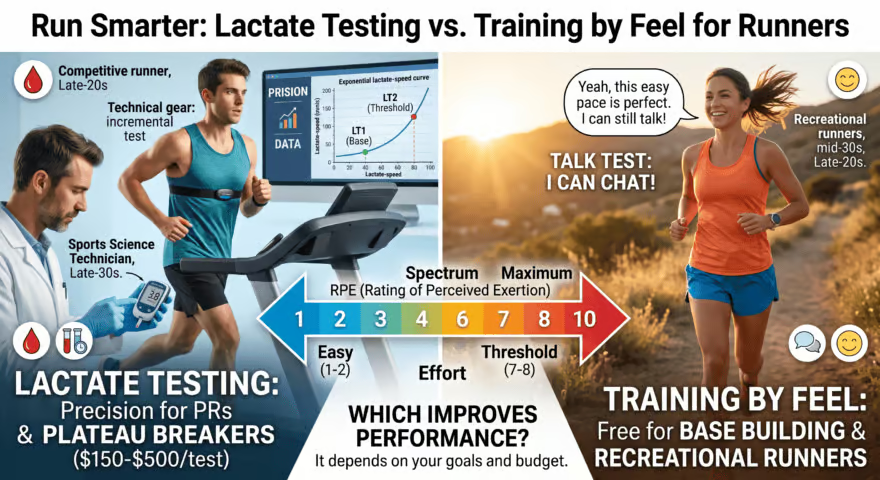
Lactate Testing for Runners: With vs Training by Feel – Which Improves Performance?
Should you invest in lactate testing for runners, or can you trust your body’s signals to optimize performance? The lactate threshold is thought of as a key marker of endurance exercise performance. Many runners rely on feel-based methods like the talk test and perceived exertion. Research shows a high correlation (r = 0.95) between muscle deoxygenation and the lactate threshold. This makes lactate threshold testing reliable to a high degree. This piece compares lactate threshold test results with training by feel and covers everything from blood lactate meter options to cost. You can decide which approach delivers better performance gains.
What Is Lactate Testing for Runners
Blood lactate concentration monitoring during exercise involves capillary blood sampling paired with incremental workload testing. The protocol starts at a low work rate and progresses so blood lactate levels remain at or near resting values throughout early stages. Exercise intensity increases every 3 to 5 minutes until it reaches one testing stage above when lactate levels reach 4 mmol/L. A technician pricks your fingertip or earlobe to measure blood lactate concentration at each stage.
How Lactate Threshold Testing Works
The test begins with a 10 to 15 minute warm-up at low intensity. This serves two purposes: it establishes an exercising baseline and lets the aerobic system engage. Stage duration matters more than most runners realize. Blood lactate doesn’t stabilize right after a workload change. Stages of at least five minutes allow lactate values time to stabilize and produce cleaner data. Shorter stages can show misleading readings where lactate appears flat at 1.5 mmol/L because the system hasn’t caught up yet.
Testing modes include treadmill running and cycling ergometry. Endurance-trained athletes get tested using exercise that resembles their competitive events. The exponential relationship between intensity and blood lactate concentration allows sport scientists to evaluate training adaptation and prescribe training intensities. Blood samples are taken at regular intervals throughout the test and analyzed for lactate concentration.
What the Numbers Tell You
Lactate concentration at rest measures 1 to 2 mmol/L but can rise to greater than 20 mmol/L during intense exertion. Two thresholds define your metabolic profile. LT1 represents the lowest intensity at which there is a sustained increase in blood lactate concentration above resting values, around 2 mmol/L. This marks the upper edge of your aerobic base training.
LT2, the second threshold, occurs at the intensity that causes rapid lactate increase when production exceeds clearance, near 4 mmol/L. The point at which lactate begins to accumulate at an accelerated rate is called the Onset of Blood Lactate Accumulation (OBLA). This represents the effort you can sustain for 20 to 60 minutes on average. Maximum Lactate Steady State (MLSS) defines the highest intensity where blood lactate increases ≤1 mM during the last 20 minutes of a 30-minute constant work rate test.
You perform at a higher rate of work without raising blood lactate levels above tested values after training. Then, lactate concentrations at various training intensities are lower and your speed at OBLA is faster.
What Is Training by Feel for Runners
Training by feel includes subjective methods that rely on internal feedback rather than external measurements. These approaches include breathing patterns, effort perception, and heart rate awareness without blood lactate data.
The Talk Test Method
The talk test uses your knowing how to speak during exercise to gage intensity. Your body switches to burning more carbohydrates as fuel once you start exercising harder. This produces carbon dioxide that must be expelled. Your breath rate accelerates, shortening expiration duration and making speech challenging.
The method classifies effort into three stages. You can speak comfortably during low-intensity workouts and have minimal difficulty. This suits warmups and easy runs. Breathing shifts noticeably at moderate intensity. You can manage short sentences, though it becomes uncomfortable. Talking becomes nearly impossible during high-intensity efforts. You can only manage a syllable or two.
Research confirms this simple approach. A 2013 study examined 18 well-trained cyclists performing incremental tests twice: once using physiological measures and once with the talk test. Participants read a 38-word paragraph aloud at each stage. The lactate threshold was identified when comfortable speech became impossible. No differences emerged between lactate threshold power or heart rate estimates using physiological data versus the talk test. Strong associations were observed between both measures.
Rating of Perceived Exertion (RPE)
Swedish researcher Gunnar Borg developed RPE in the 1960s as a quantifiable measure of exercise intensity. The original Borg scale ranged from 6 to 20. Adding a zero would approximate working heart rate. Borg revised this to a simpler 0 to 10 scale in the 1980s.
A 2024 study involved over 6,000 participants using stationary cycles or treadmills. The Borg RPE scale indicated physical signs of exercise intensity, including blood lactate, VO2 max, and heart rate. Earlier research studied 2,560 men and women during incremental exercise tests. RPE strongly associated with heart rate and blood lactate concentration (r>0.74; p<0.001).
The relationships between heart rate, blood lactate, and RPE remained consistent in continuous and alternated-intensity protocols. This consistency means you can use determined RPE to prescribe training in different workout types.
Heart Rate Monitoring Without Lactate Data
Heart rate monitoring without lactate threshold testing provides objective data about cardiovascular response. Lactate testing requires blood samples and equipment. Heart rate monitoring tracks exertion through pulse measurements alone.
You create a more complete picture by combining heart rate with RPE than either method alone. Heart rate delivers objective numbers. RPE captures breathing rate, muscle fatigue, mental strain, cumulative stress, and recovery state. Wrist-based monitors use photoplethysmography technology and measure blood volume changes rather than direct heartbeats.
Heart rate adapts as fitness improves. Your aerobic system becomes more efficient and increases stroke volume. This delivers more blood per heartbeat and reduces overall heart rate at any given effort. This adaptation explains why depending solely on heart rate zones can cause confusion about actual training stress.
Performance Gains: Lactate Testing vs Training by Feel
Runners who train with lactate data outperform those relying on perceived effort alone. Tested runners clear lactate 34% faster at threshold and 64% faster at lower intensities than those training by feel. This metabolic advantage translates to superior recovery capacity and performance gains that stay consistent.
Speed Improvements at Threshold
Lactate threshold stands as a stronger predictor of endurance performance than VO2 max. Your pace at lactate threshold responds well to training and is straightforward to measure without laboratory access. You spare muscle glycogen and decrease blood lactate production when you increase workload at a faster aerobic pace through proper training.
Training creates a rightward move in your lactate curve. You sustain higher intensities before lactate builds up. Lower baseline lactate values point to better aerobic efficiency, while higher power at LT2 demonstrates increased endurance capacity. Elite marathon runners maintain lactate threshold speeds ranging from 18-21 km/h. They hold faster paces for extended periods without excessive fatigue.
Field-based lactate threshold estimates from 20-minute tests can miss your actual threshold by around 5%. For competitive athletes, this margin represents the difference between optimal training stimulus and overtraining risk.
Time to See Measurable Results
Measurable lactate threshold improvements appear within four to six weeks of proper training. Well-trained athletes may need closer to six to twelve weeks before noticing changes. Adaptations become smaller and require longer development periods.
Training frequency and quality influence your timeline. Programming designed to improve lactate threshold produces faster adaptations than irregular workouts or plans lacking intentional structure. The physiological adaptations behind threshold improvements include greater cardiac output, increased mitochondria in muscle cells, and reduced lactate production at given intensities.
Long-Term Performance Tracking Accuracy
Regular lactate testing every six to eight weeks helps monitor metrics and adjust training. This prevents overtraining while optimizing performance gains. A history of tests reveals changes in fitness characterized by increased power and pace at threshold, improved recovery heart rate, higher lactate threshold heart rate, and better pace or power-to-weight ratio.
Rating of perceived exertion shows strong correlation with heart rate and blood lactate concentration (r>0.74; p<0.001). Blood lactate, heart rate, and RPE relationships remain consistent across continuous and alternated-intensity protocols. This consistency allows you to use determined RPE for prescribing training across different workout types.
Which Method Prevents Overtraining Better
Lactate testing reveals how your body handles training stress beyond simple numbers. A leftward move in your lactate curve signals overtraining or poor recovery. You produce more lactate at lower intensities than before. Lab tests on overtrained athletes showed major drops in their abilities to produce lactate. Failed lactate production increases persisted after two-week recovery periods.
Training interpretation should include recent training history, recovery status, and fatigue levels. Balanced against this precision, RPE captures breathing rate, muscle fatigue, mental strain, and recovery state without equipment requirements. In spite of that, you train blind to your actual physiological responses without baseline metrics from testing.
Cost and Accessibility Comparison
Financial barriers separate these two training approaches more than any technical aspect. Your location heavily determines access to sports science facilities, and pricing reflects regional variations in healthcare and sports medicine costs.
Lab Lactate Threshold Test Pricing ($200-$500)
Professional lactate threshold assessments range from $150 to $500 per session. Services operate on a fee-based model not covered by insurance, though many athletes use FSA or HSA funds for reimbursement. You remain responsible for pursuing reimbursement, with itemized receipts available upon request.
Lab tests provide extensive printouts of blood lactate readings at various paces. The process requires scheduling appointments, traveling to specialized facilities and coordinating with trained technicians. Repeat testing becomes challenging and expensive for runners monitoring progress throughout a training cycle.
Free Training by Feel Methods
Training by feel requires zero financial investment. The talk test and rating of perceived exertion cost nothing to implement. Heart rate monitoring without lactate data is also free. These methods rely entirely on your body’s feedback signals, unlike laboratory equipment and blood sampling devices.
Many runners already own basic heart rate monitors from fitness trackers or running watches purchased for other purposes. The talk test and RPE provide guidance for structuring training intensities across different workout types, even without technology.
Time Investment for Each Approach
Lab testing demands a lot of time beyond the test itself. You schedule appointments weeks ahead, travel to facilities, complete paperwork and wait for results analysis. The actual testing protocol takes 45-60 minutes, with total time commitment often exceeding two hours.
At-home lactate meters eliminate scheduling and travel but require learning proper testing protocols. You perform tests on your own timeline and repeat measurements as frequently as needed without coordinating with external facilities. Training by feel requires no setup time whatsoever. You start running and gage intensity through breathing patterns and effort perception right away.
Who Should Use Lactate Testing
Lactate testing serves specific athlete populations better than others. Your training status, goals, and current limitations determine whether this investment produces meaningful returns.
Competitive Runners Training for PRs
Personal record pursuers gain concrete advantages from lactate threshold testing. Research demonstrates that increasing standard performance models with lactate data explains an additional 4.4% of variance in 5000-m time trial performance. This results in a total explained variance of 79.8%. To cite an instance, well-conditioned endurance runners maintain a 10K race pace slightly faster than their lactate threshold pace. Testing identifies your maximum sustainable pace and allows you to structure long training runs with precision. You can also design interval workouts based on this data.
Athletes testing 2-4 times per year build a performance history. This history shows increased power at threshold, improved recovery heart rate, and higher pace-to-weight ratios. Elite athletes and seasoned marathoners benefit from understanding their current fitness level along heart rate zones. Consistency drives lactate threshold improvement, so regular testing provides concrete evidence of progress beyond feel alone.
Plateau Breakers Who Just Need Precision
Stagnant performance despite consistent training signals a need for physiological assessment. Lactate testing reveals your current fitness level and identifies areas of weakness along your heart rate zones. The data might show strong top-end output but a relatively underdeveloped aerobic base or the opposite profile.
Plateauing runners who remain unsure how hard easy days should be gain clarity from threshold data immediately. Testing spots exactly where you’re limited metabolically. This makes it easier to set training zones with precision and establish meaningful performance measures.
Runners With Specific Race Goals
Marathon training demands knowing your lactate threshold because pace at this threshold typically matches the pace you can maintain for 26.2 miles. Testing eliminates guesswork about appropriate training paces for long runs and tempo workouts. Measureable lactate threshold improvements appear within four to six weeks of proper training. This necessitates retests to adjust minimum training paces.
Testing proves valuable when training for races, returning after injury, or struggling with pacing. Runners who fade late in workouts and races also benefit. Like in volume increases, runners benefit from objective intensity boundaries that prevent overtraining.
When Training by Feel Stops Working
Runners struggle with training intensity distribution frequently. They run too hard on easy days and not hard enough on specific days. This pattern guides them to fatigue, plateaus, and inconsistent race results. Testing reveals why certain paces feel harder than expected and whether training intensity is distributed appropriately. Without lactate data, you train blind to actual physiological responses and miss opportunities to optimize each training session’s purpose.
Who Should Stick With Training by Feel
Not every runner benefits from blood lactate meter data or lactate threshold test precision. Several populations achieve their goals better through feel-based methods.
Beginner Runners Building Base Fitness
Base training is the foundation for running success and requires at least 80% of effort at a comfortable pace. Aerobic development occurs without excessive stress on the body. Lactate testing for runners is unnecessary during the original fitness building phase. Novice runners need to raise their fitness level before they tackle structured training programs. The talk test provides sufficient guidance to maintain appropriate intensity. If you struggle to hold a conversation while running, you’re running too hard.
You should increase mileage before intensity to prevent overreaching. Roughly 10% weekly increases are recommended. Base training helps avoid injury through lower intensity and consistent running. It prevents overtraining by increasing aerobic capacity without additional strain. Physiological testing adds little value as long as you maintain easy paces throughout this foundation phase.
Recreational Runners Without Race Goals
Recreational runners train during leisure time with varied objectives that include enjoyment, health and social interaction rather than competition. You can run without race pressure or time goals as an important part of enjoying exercise and finding it relaxing. Base training year-round is possible if you lack race goals, though it might become boring.
The simplicity and accessibility of running favors health development and social experiences for most people whatever their level or age. Training by feel matches your priorities when your focus centers on physical fitness rather than performance measures.
Budget-Conscious Athletes
Running on a budget requires strategic choices. All you need is shoes that fit to keep running. Everything else can wait until finances improve. Free group runs through running specialty stores provide community without membership fees.
Runners Who Respond Well to Intuitive Training
Intuitive running means tuning into your body’s signals to know when to push and when to back off. Some runners possess strong interoception that allows them to sense heart rate, breathing, temperature and digestion accurately. This body awareness enables knowing exactly what the right pace feels like and how much you can push. Intuitive running encourages using a range of paces and distances guided by how you feel rather than strict prescribed pacing.
Comparison Table
Comparison Table: Lactate Testing vs Training by Feel for Runners
| Attribute | Lactate Testing | Training by Feel |
| Original Cost | Lab tests: $150-$500 per session | $0 (completely free) May use existing heart rate monitors from fitness trackers |
| Time Investment | Lab: 45-60 minutes testing + 2+ hours total (travel and scheduling included)
Mobile Testing: 45-60 minutes testing |
No setup time required Immediate implementation during any run |
| Methods/Tools | • Blood lactate meters • Capillary blood sampling • Incremental workload testing |
• Talk test (speech ability during exercise) • Rating of Perceived Exertion (RPE) scale (0-10 or 6-20) • Heart rate monitoring without lactate data |
| Accuracy/Precision | • High correlation with muscle deoxygenation (r = 0.95) • Precision uncertainty: ±0.3 to 0.4 mM • Field-based estimates can miss actual threshold by ~5% |
• Strong correlation with heart rate and blood lactate (r>0.74; p<0.001) • Talk test shows no differences vs physiological measures • Subjective, relies on individual perception |
| Performance Gains | • Clear lactate 34% faster at threshold, 64% faster at lower intensities • Explains additional 4.4% variance in 5000-m performance (79.8% total) • Lactate threshold is stronger predictor than VO2 max |
• Reliable indicator of intensity • Consistent across different workout types • No quantified performance advantage data provided |
| Time to Results | Measurable improvements in 4-6 weeks Well-trained athletes: 6-12 weeks Recommended retesting every 6-8 weeks |
Not mentioned Adaptations occur but without precise tracking |
| Overtraining Prevention | • Detects leftward shift in lactate curve (overtraining signal) • Shows failed lactate production in overtrained athletes • Provides objective metabolic data |
• Captures breathing rate, muscle fatigue, mental strain and cumulative stress • No baseline metrics = “training blind” to physiological responses |
| Availability | Requires specialized equipment or lab facilities Lab tests need scheduling weeks in advance Geographic limitations for lab access |
Available to all runners immediately No equipment or facilities required Can be used anywhere, anytime |
| Best Suited For | • Competitive runners training for PRs • Plateau breakers needing precision • Runners with race goals • Elite athletes and seasoned marathoners • Those who can test 2-4 times per year |
• Beginner runners building base fitness • Recreational runners without race goals • Budget-conscious athletes • Runners who respond well to intuitive training |
| Key Advantages | • Precise training zone identification • Objective physiological data • Tracks fitness changes over time • Identifies metabolic weaknesses • Optimizes each training session’s purpose |
• Zero financial investment • No learning curve • Sufficient for base training (80% of effort) • Promotes body awareness and interoception • Simple and implementable immediately |
| Key Limitations | • Expensive for regular testing • Requires blood sampling • Time-consuming (lab tests especially) • Learning curve for at-home testing • Ongoing strip costs |
• Less precise for competitive goals • No objective metabolic data • Can lead to training too hard on easy days • Difficult to track long-term progress quantitatively • May miss 5% threshold accuracy |
| Typical Use Case | Marathon pace = lactate threshold pace 10K race pace slightly faster than threshold Testing reveals exact maximum sustainable pace |
Base training at comfortable, conversational pace Using RPE to guide intensity across workout types 80%+ of training maintained at easy effort |
Conclusion
The lactate testing versus training by feel debate doesn’t have a universal answer. Lactate testing delivers superior performance gains to competitive runners, with 34% faster lactate clearance at threshold and measurable improvements within four to six weeks. Budget-conscious runners and beginners building base fitness will find training by feel adequate.
All things thought over, your choice depends on your race goals and your budget. Competitive athletes chasing PRs benefit from the precision worth $150-$300. Recreational runners enjoying the sport without time goals can trust the talk test and RPE.
Your body signals work until they don’t. When progress stalls despite consistent effort, lactate testing reveals why.
Key Takeaways
Runners who train with lactate data clear lactate 34% faster at threshold and 64% faster at lower intensities compared to those training by feel alone, translating to superior recovery and consistent performance gains.
The decision between lactate testing and training by feel depends on three critical factors:
• Competitive runners training for PRs should invest in lactate testing – It explains an additional 4.4% variance in race performance and provides precise training zones, with measurable improvements appearing within 4-6 weeks of proper training.
• Beginner and recreational runners can rely on training by feel – The talk test and Rating of Perceived Exertion (RPE) show strong correlation with physiological measures (r>0.74) and cost nothing, making them ideal for base building and non-competitive goals.
• Cost accessibility differs dramatically – Lab tests run $150-$500 per session while at-home blood lactate meters cost $150-$300 as a one-time investment, whereas training by feel methods remain completely free and immediately accessible.
• Lactate testing prevents overtraining more effectively – It detects leftward shifts in your lactate curve signaling overtraining before performance declines, while training by feel leaves you “blind” to actual physiological responses without baseline metrics.
• When progress stalls, testing reveals why – Plateau breakers gain precision by identifying metabolic weaknesses and exact training intensity boundaries that feel-based methods cannot quantify.
The bottom line: Lactate testing delivers measurable performance advantages for goal-oriented athletes willing to invest $150-$300, while training by feel serves recreational runners perfectly at zero cost. Your body signals work until they don’t—when consistent effort stops producing results, lactate data shows exactly what needs adjustment.
FAQs
Q1. Is lactate testing a worthwhile investment for runners? Lactate testing provides significant value for competitive runners seeking performance improvements. Runners who train with lactate data clear lactate 34% faster at threshold and 64% faster at lower intensities compared to those training by feel. The testing reveals precise training zones and can explain an additional 4.4% variance in race performance. However, for recreational runners without specific race goals, the $150-$500 cost may not justify the benefits, as free training-by-feel methods work adequately for general fitness.
Q2. Can you run a 10K race at your lactate threshold pace? Well-conditioned endurance runners typically maintain a 10K race pace that is slightly faster than their lactate threshold pace. Your lactate threshold represents the maximum sustainable pace you can hold for extended periods, and elite runners can push just beyond this threshold for the duration of a 10K race. Testing helps identify your exact threshold pace, allowing you to structure training runs and intervals with precision for optimal 10K performance.
Q3. How quickly can you see performance improvements from lactate-based training? Measurable lactate threshold improvements typically appear within four to six weeks of proper training for most runners. Well-trained athletes may need closer to six to twelve weeks before noticing changes, as their adaptations become smaller and require longer development periods. Regular testing every six to eight weeks helps monitor these metrics and adjust training accordingly, preventing overtraining while optimizing performance gains.
Q4. What are the most reliable free methods for training without lactate testing? The talk test and Rating of Perceived Exertion (RPE) are highly reliable free alternatives to lactate testing. Research shows the talk test produces no significant differences compared to physiological lactate measures, while RPE demonstrates strong correlation with heart rate and blood lactate concentration (r>0.74). These methods work consistently across different workout types and require no equipment, making them ideal for beginner runners building base fitness and budget-conscious athletes.
Q5. How does lactate testing help prevent overtraining better than training by feel? Lactate testing reveals overtraining through a leftward shift in your lactate curve, showing increased lactate production at lower intensities than previous tests. This objective data detects overtraining before performance significantly declines, whereas training by feel leaves you without baseline metrics to compare against. Lab tests on overtrained athletes show significant drops in lactate production abilities that persist even after two-week recovery periods, making early detection through testing crucial for competitive athletes.





