
Ironman Training: A 20-Week Beginner’s Guide to Success
October 25, 2026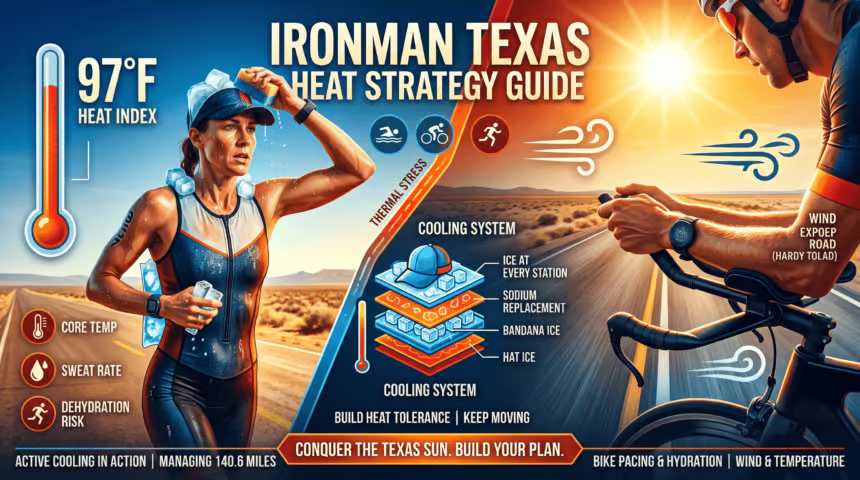
A heat index of 97°F puts your body under extreme thermal stress even at complete rest. Now picture racing 140.6 miles through it.
IRONMAN Texas doesn’t just test your fitness. It tests your heat strategy. The course throws a point-to-point swim at you, a wind-exposed 112-mile bike route with only 1,224 feet of elevation gain, and a multi-loop run where temperatures climb and shade disappears. Athletes who cross the finish line strong here rarely do it by luck. Success comes down to preparation and disciplined heat management.
Here’s the uncomfortable truth most athletes ignore: losing just 2% of your body weight through dehydration is enough to wreck your performance. Yet race after race, athletes underestimate exactly how much thermal load this course carries.
This guide breaks down how to build your heat tolerance before race day, how to execute smart cooling strategies on the course, and how to keep moving when the Texas sun turns absolutely brutal.
The Science of Racing in Texas Heat
How Heat Affects Your Body During IRONMAN
Here’s something most athletes don’t realize: 75% of energy your muscles produce during the bike and run converts directly into heat waste. Not forward motion. Heat. That heat triggers a cascade your body wasn’t designed to handle for 10+ hours.
Skin blood flow surges to pull heat away from working muscles. The problem? That same blood gets diverted away from the muscles doing the actual work, cutting your aerobic capacity at the source. Meanwhile, your sweat rate climbs between 1.0 and 1.5 liters per hour during vigorous exercise in hot conditions — with some athletes pushing past 2.5 liters per hour.
Core temperature exceeding 38.5°C (101.3°F) marks the onset of hyperthermia. At the 2014 Ironman World Championship, the average marathon core temperature hit 38.55°C — and stayed elevated for at least 60 minutes after athletes crossed the finish line. Push past 40°C (104°F) and your central nervous system starts breaking down, producing dizziness, disorientation, and loss of coordination.
Dehydration makes every one of these effects worse. Each 1% drop in body weight raises your rectal temperature by 0.2 to 0.4°C during exercise. Cross the 2% body mass deficit threshold and aerobic performance degrades measurably in warm-hot conditions. Your cardiovascular system fights to maintain blood pressure as plasma volume shrinks and cardiac filling drops.
Understanding Heat Index and Performance Impact
Temperature alone tells you very little. Heat index factors in humidity to give you the actual thermal load your body experiences. The difference is significant. At 30°C (86°F) with 50% humidity, the heat index sits at 31°C (88°F) — slowing marathon pace by 2 to 3%. Bump humidity to 80% and the heat index jumps to 38°C (100°F), with pace dropping 5% or more.
Performance starts deteriorating around 20°C (68°F). Mid-pack age groupers feel it hardest — up to 10 to 15% impairment at that temperature. Elite athletes suffer roughly 5% due to their faster finish times. The encouraging data? Danish cyclists who took a 15% performance hit training in Qatar’s 30 to 36°C conditions recovered 98% of their performance after just two weeks of heat training. Adaptation is real. It works. You just have to do it.
Common Heat-Related Mistakes Athletes Make
Athletes make the same mistakes in the heat, race after race. Knowing them in advance keeps you off that list.
- Starting too aggressively triggers heart rate spikes that become nearly impossible to reverse once temperatures climb. Controlled pacing from the gun is non-negotiable.
- Skipping electrolyte replacement is a critical error. Heat racing bumps your sodium requirements to 800–1000mg per hour during competition. Plain water won’t cut it.
- Pacing by speed instead of effort forces your body to chase targets that heat has already made unrealistic. Power and heart rate are your reliable guides here.
- Skipping heat acclimation leaves your body completely unprepared, while doing excessive warmup before race start pre-loads your core temperature before you’ve even started.
- Drinking only plain water without sodium replacement can trigger hyponatremia — which produces symptoms eerily similar to dehydration itself.
Each of these mistakes is avoidable. The next sections show you exactly how.
Building Your Pre-Race Heat Adaptation Plan
4-6 Week Heat Training Protocol
Heat acclimatization isn’t optional for IRONMAN Texas. It’s the difference between finishing strong and watching your race unravel by mile 10 of the run.
Most physiological adaptations happen within the first week of heat training — decreased heart rate, lower core temperature, increased sweat rate, and improved work capacity. For near-complete cardiovascular and sudomotor adaptations, you need 6-10 days. Two full weeks is optimal for maximizing aerobic performance in hot conditions.
Here’s how to structure your protocol:
- Each session should last 60-75 minutes — enough to drive adaptation without burying your regular training
- Target 75-80% of maximum heart rate, dropping to 70-75% if conditions are particularly brutal
- Your core temperature should reach 38.5-39°C (101.3-102.2°F) during sessions, but cap them at 75 minutes to avoid excessive fatigue
Timing matters just as much as the sessions themselves. Start your heat training 4-6 weeks out from race day. Well-trained athletes need only three days of recovery after a pre-race heat block, while less conditioned athletes benefit from 5-6 days. Already heat-adapted from recent training? Three to four sessions starting around 10 days before the race may be all you need. Without any recent heat exposure, aim for at least 10 sessions within 14 days, beginning roughly 21 days before IRONMAN Texas.
Sweat Testing and Personalized Hydration Planning
Did you know sodium loss in sweat varies by as much as 15-fold between athletes — ranging from 200mg per liter all the way to 2,000mg/L? That single fact explains why generic hydration plans fail so many athletes on race day.
Professional sweat testing takes about 45 minutes and gives you your exact sodium concentration. Heat-acclimatized athletes lose approximately 500mg/L of salt through sweat. Non-acclimatized athletes can lose up to 2,500mg/L — five times as much.
Your targets:
- Aim for 500-1,000mg of sodium per liter of water
- A quarter teaspoon of table salt contains 590mg of sodium — a useful reference point
A personalized hydration strategy built around your individual fluid and sodium loss rates keeps you optimized regardless of what race day conditions throw at you.
Race Week Heat Exposure Guidelines
Arriving early pays off. Five days before IRONMAN Texas gives your body a chance to semi-adapt to the local temperature and humidity. If you can manage 10 days prior, do it — that’s enough time for meaningful acclimatization to extreme climate shifts.
Use those first couple of days strategically. Schedule taper sessions early in the morning before the heat builds, then spend short periods outside rather than hiding in air conditioning all day. After that initial adjustment window, flip your session timing — train during the hottest part of the day. Keep air conditioning use to a minimum where you can, but don’t sacrifice sleep for heat exposure. Sleep wins every time.
What to Pack for Hot Weather Racing
Your gear choices directly affect how well your body manages heat on course. Pack with intention:
- Light-colored clothing — reflects sunlight and helps keep your temperature down during the race
- Ice vest or cooling accessories — position ice near your femoral artery, head, and hands for maximum cooling effect
- One extra bike bottle beyond your normal setup — use it for backup hydration or to pour cooling water over your head
- Your own sunscreen — don’t count on finding it in gear bags or transition areas
- Hat or visor — keeps direct sun off your head, face, and neck, and doubles as an ice carrier at aid stations
Small details here create big advantages when temperatures peak during the run.
Race Day Execution: IRONMAN Texas Course Strategy
Swim Start Through Transition Planning
Transition opens at 5:00 AM and closes at 6:15 AM. Bring a headlamp – the transition area is dark and finding your gear in the chaos costs time you don’t want to lose.
The swim start sits approximately 1 mile from transition, so plan for the walk to North Shore Park. Lake Woodlands holds an average temperature of 82°F, which puts wetsuit legality in uncertain territory. Know the rules before race morning. The 2.4-mile point-to-point course includes one turnaround before the canal feeds you into Town Green Park.
Swim straight. Sight aggressively near buoys. Every extra meter you swim in this heat costs you on the run. Delay pulling on your wetsuit until 5-10 minutes before your wave goes off – there’s no reason to bake in neoprene longer than necessary.
IRONMAN Texas Bike Course Pacing in Heat
The 112-mile bike course runs two loops on Hardy Toll Road with only 1,224 feet of elevation gain. Flat doesn’t mean easy. The heat and wind make sure of that.
Your first hour on the bike is a hydration window, not a performance window. Fix the sodium deficit the swim created. Set an alarm on your watch to eat and drink on schedule – it’s easy to forget when you’re focused on pace and the road ahead. Fuel aggressively here because blood flow shifts away from your gut once you step off the bike. Carry one extra bottle beyond your normal setup for backup hydration or to dump cold water over your head.
Managing Wind and Temperature on Hardy Toll Road
Hardy Toll Road delivers headwinds heading south and tailwinds heading north. Accept it and move on.
Ignore the wind from a pacing standpoint. Don’t chase the tailwind sections and don’t fight the headwind sections. These mistakes seem small in the moment but they stack up across the extended one-direction stretches. Stay in aero position when safe – sitting upright turns your body into a sail. Keep your power output steady and resist the urge to surge against gusts. Consistency wins here. Drama costs watts.
Run Course Cooling System
The 26.2-mile run covers three laps with 493 feet of elevation gain. By this point in the race, the sun is fully up and the mercury is climbing.
Ice at every aid station is non-negotiable. Not optional. Not situational. Every single station. Place ice down your jersey front, in your hands, over your head, and on your neck. Many athletes swear by a bandana held around the neck to keep ice in contact with skin longer. Fill your hat with ice at each station and replace it as it melts.
Use the aid stations as planned walking breaks. This isn’t weakness – it’s strategy. Walking for 30-45 seconds while taking in fluids, electrolytes, and calories is far smarter than shuffling past and skipping nutrition entirely.
Mental Strategies When Heat Gets Tough
Here’s something worth remembering when the heat gets inside your head: every athlete on that course is dealing with the same conditions. The temperature isn’t targeting you specifically.
Replace the negative spiral with realistic, grounded statements. “You’ve trained for this.” “Make the necessary adjustments.” These aren’t empty affirmations – they’re accurate. Break the run into manageable pieces rather than staring down the full 26.2 miles. Focus on the next aid station. Then the next lap. That’s it.
Practice positive self-talk and shut out the noise of what other athletes around you are doing. Your execution plan is the only plan that matters on race day. Stick to it.
Emergency Protocols and Recovery
When to Slow Down or Stop
Your body sends signals before it shuts down. The problem is that most athletes ignore them.
Dizziness, nausea, headache, rapid heart rate, and fatigue that feels completely out of proportion to your effort – these are your core temperature rising and screaming for attention. Don’t rationalize them away. Don’t tell yourself it’s just a hard patch.
Confusion or disorientation changes everything. The moment your mental state shifts, stop immediately. Altered awareness defines heatstroke, and heatstroke demands medical intervention – not another gel and a cup of water. Watch for one more critical sign: you’ve stopped sweating despite still moving. That means your thermoregulation system has failed. Chest pain, lightheadedness, or the complete absence of sweat are your cues to step off the course, find shade, and get medical help.
Helping Fellow Athletes in Distress
Never walk past a struggling athlete and assume someone else will handle it.
Alert race officials or volunteers the moment you spot someone in trouble. Don’t leave them alone – stay until medical personnel or race officials take over. For heatstroke symptoms like confusion or unconsciousness, call 911 immediately. Cool the entire body with ice baths or soaked clothing while fanning vigorously. Small ice packs won’t cut it here. Full-body cooling is the only effective response.
Post-Race Heat Recovery
Crossing the finish line doesn’t mean your body has stopped fighting the heat. Your rising core temperature continues stressing your cardiovascular system long after you stop moving.
Get into air conditioning immediately. Elevate your legs above heart level for 10 to 15 minutes. Drink 20 to 24 oz of fluid for every pound of body weight you’ve lost. Add sodium back in – target 1 gram per hour in the hours that follow.
Learning from Your Heat Performance
Recovery is data. Track your resting heart rate, energy levels, sleep quality, and motivation in the days after the race. One metric dipping is normal. Multiple metrics trending downward at the same time tells you your body needs more time. Give it that time. The fitness you’ve built isn’t going anywhere.
Conclusion
Heat acclimation gets you to the start line ready. Hydration planning keeps you moving through mile 80. Disciplined pacing carries you across the finish.
That’s the difference between athletes who conquer IRONMAN Texas and those who watch their race unravel on the run course.
The Texas sun doesn’t care how many hours you’ve trained. It will push back hard. But you’ve done the preparation. You know your warning signs, your sodium targets, your cooling strategy, and your pacing limits. That knowledge matters more than raw fitness when temperatures soar past 97°F.
Execute your plan at every aid station. Adjust when your body demands it. And trust the work you put in before race day.
Race smart, stay cool, and that finish line is yours.
Key Takeaways
Racing IRONMAN Texas in extreme heat demands more than fitness—it requires strategic preparation and disciplined execution to overcome thermal stress that can derail even the strongest athletes.
• Start heat acclimation 4-6 weeks before race day with 60-75 minute sessions at 75-80% max heart rate to develop critical cardiovascular and sweat adaptations that improve performance by up to 15%.
• Personalized hydration is non-negotiable since sodium loss varies 15-fold between athletes (200-2,000mg/L); target 500-1,000mg sodium per liter and replace 20-24oz fluid per pound lost.
• Pace by effort, not speed on the bike and run, using power or heart rate metrics to prevent the aggressive early pacing that causes irreversible performance collapse in heat.
• Ice at every aid station is your lifeline during the run—place it down your jersey, in your hands, on your neck, and in your hat to manage core temperature that can exceed 101°F.
• Recognize emergency warning signs immediately: confusion, stopped sweating, or altered mental state require stopping activity and seeking medical help to prevent life-threatening heatstroke.
Heat management separates successful IRONMAN Texas finishers from DNFs. Your body can adapt remarkably well to thermal stress through proper acclimation, but race day execution—controlling pace, maintaining hydration, and aggressively cooling at aid stations—determines whether you cross the finish line strong or struggle to survive the Texas sun.
FAQs
Q1. How far in advance should I start heat training for IRONMAN Texas? Begin your heat training protocol 4-6 weeks before race day. Most physiological adaptations occur within the first week, but you’ll need 6-10 days for near-complete cardiovascular and sweat adaptations. Each session should last 60-75 minutes at 75-80% of your maximum heart rate. If you’ve been recently heat-adapted, you may only need 3-4 sessions starting around 10 days before the race.
Q2. What are the most common mistakes athletes make when racing in hot conditions? The biggest mistakes include starting too aggressively, which causes heart rate spikes that are difficult to reverse in heat; ignoring electrolyte replacement when sodium needs increase to 800-1000mg per hour; pacing based on speed rather than effort metrics like power or heart rate; and skipping heat acclimation training. Additionally, drinking only plain water without sodium can lead to hyponatremia, which produces symptoms similar to dehydration.
Q3. How should I adjust my bike pacing strategy for the heat on Hardy Toll Road? Focus on maintaining steady power output regardless of wind conditions. Don’t increase effort into headwinds or decrease with tailwinds, as these mistakes accumulate over the extended one-direction sections. Your first hour should prioritize fluids and sodium to address the hydration deficit from the swim. Carry one extra bottle beyond your normal setup for backup hydration or head cooling, and set alarms to remind yourself to eat and drink regularly.
Q4. What cooling strategies should I use during the IRONMAN Texas run course? Ice at every aid station is essential. Place ice down your jersey front, in your hands, over your head, and on your neck. Fill your hat with ice and replace it at each station. Consider using a bandana to hold ice around your neck. Utilize aid stations as planned walking breaks to ensure proper fluid, electrolyte, and caloric intake while managing your core temperature.
Q5. What warning signs indicate I should slow down or stop during the race? Stop immediately if you experience confusion, disorientation, or altered mental state, as these define heatstroke and require medical intervention. Other critical warning signs include dizziness, nausea, headache, rapid heart rate, disproportionate fatigue, and absence of sweat despite continued exertion. If you experience chest pain, lightheadedness, or stop sweating altogether, cease racing, move to shade, and seek medical attention.