How Houston’s Humidity Affects Your Open Water Swimming Practice
August 28, 2026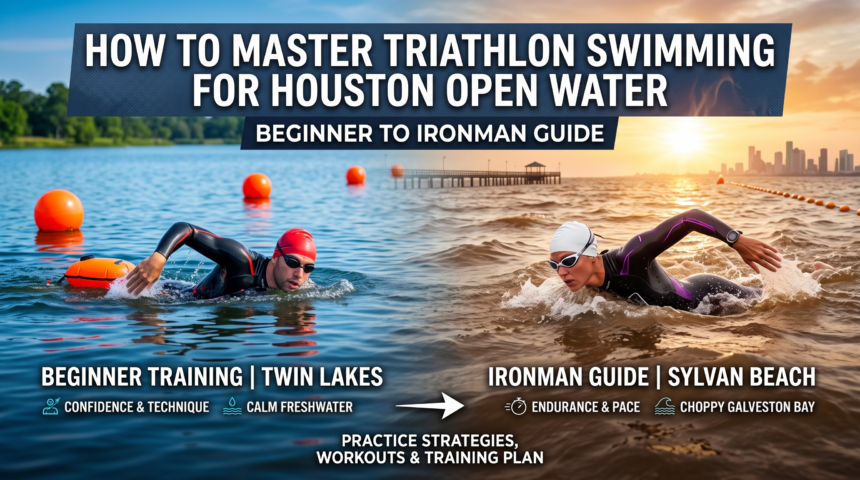
How to Master Triathlon Swimming Training for Houston Open Water: Beginner to IRONMAN Guide
The swim leg scares beginner triathletes more than anything else on race day. Ask any first-timer what keeps them up at night before their race – it’s not the bike, it’s not the run. It’s the water.
Houston makes that fear even harder to shake. Your triathlon swimming training here doesn’t just battle technique gaps and fitness limitations. It battles wind, currents, and choppy waves in natural bodies of water – from open bays to freshwater lakes and reservoirs – all while fighting the Gulf Coast’s punishing heat and humidity. Swimming is already one of the most mentally and physically demanding segments of any triathlon. Houston’s conditions take that challenge up another level entirely.
Here’s what this guide covers: everything from beginner triathlon swimming training at Twin Lakes to full IRONMAN swimming preparation at Sylvan Beach. You’ll find open water swimming practice strategies, swimming workouts built specifically for triathlete beginners, and a training plan shaped around Gulf Coast racing conditions.
Whether you’re just learning to stay afloat past 50 meters or building toward a 2.4-mile race swim – this is where you start.
Getting Started with Triathlon Swimming in Houston
Assessing Your Current Swimming Level
Know where you stand before building your open water swimming training plan. Jumping into advanced workouts without this step is one of the fastest ways to stall your progress.
Triathlon swim training falls into three clear levels:
- Level 1 – Water confidence and basic technique. You can swim 25-50 meters continuously and are still developing breathing patterns and body position.
- Level 2 – You’ve completed one or two races and are focused on improving pacing and stroke efficiency across 400-800 yard intervals.
- Level 3 – Performance-driven training through advanced pacing strategies and threshold work over 1000+ meter sets.
Honest self-assessment sets the foundation for realistic goals in your beginner triathlon swimming training. If your technique feels off – breathing, body position, alignment, rotation, stroke mechanics – work with a swim coach before piling on volume. Adding distance on top of a broken stroke just makes bad habits harder to fix.
Finding Safe Open Water Training Locations
Houston gives you solid options for open water practice, each with its own character.
Twin Lakes Scuba Park in Manvel sits about 25 miles from Houston. Calm water and good visibility make it a reliable choice for Houston open water swim training, especially for beginners building confidence. Entry costs $10 per person (cash only). Every swimmer must wear either a full wetsuit or personal flotation device – no exceptions, due to liability insurance requirements. Sleeveless wetsuits are fine, but full legs are mandatory.
Lake Longhorn in League City offers a 43-acre freshwater lake purpose-built for triathlon training. Sign a waiver before entering, and bring or buy a personal swim buoy on-site. There are no lifeguards on duty. Check before you go as the location’s website indicates temporarily closed.
Sylvan Beach puts you directly in Galveston Bay, roughly 25 miles from the city center. Conditions here can get choppy – much closer to real race conditions. The brown water color comes from suspended sediment, not pollution. Consider that a feature, not a bug, when preparing for open water racing.
Essential Gear for Gulf Coast Swimming
Get your gear right before your first open water session. A poor equipment choice costs you more than money – it costs you time and performance.
Start with quality goggles that seal properly. Leaking goggles mid-race are a distraction you don’t need. Add a brightly colored swim cap for visibility and sun protection. Personal swim buoys are mandatory at most Houston-area open water locations – and worth having regardless, since a properly rated buoy can support a 250-pound swimmer in an emergency.
Wetsuits are where Gulf Coast swimmers face a specific wrinkle. USA Triathlon rules permit wetsuits in water below 78°F, make them optional up to 83.8°F, and prohibit them entirely above that threshold. The trouble? Gulf Coast water temperatures regularly blow past these limits. Plan for early-season transitions to swimskins or neoprene-free training – Houston’s climate makes it unavoidable.
Beginner Triathlon Swimming Training Timeline
Sprint triathlon training plans typically run 4, 8, or 12 weeks depending on your starting fitness level. For beginners, schedule at least two pool sessions per week to build comfort and confidence in the water.
A 6-week structured plan works well for athletes who can already swim 25-50 meters without stopping. Progress through three sessions per week with gradually increasing volume and intensity.
One number to keep in mind: sprint distance covers 750 meters, with a typical 30-minute cutoff. That translates to a maximum pace of four minutes per 100 meters. Use that as your early benchmark.
Mastering Pool Training and Open Water Transition
Building Swimming Endurance in the Pool
Here’s something most triathletes don’t realize until race day: the pool teaches you habits that open water punishes.
Every time you flip-turn and push off the wall, your legs do the work. You accelerate for free. That advantage disappears the moment you hit Galveston Bay or step into Twin Lakes. Perform long swims of 500 to 1000 meters without touching the wall. Flip at the T – five feet before the wall – and keep moving. Your momentum drops to zero. Your arms and legs have to rebuild it from scratch. That’s exactly what open water demands on every single stroke.
Long, steady sets build the cardiovascular base for race-duration swimming. A solid starting workout: 3×500 at moderate pace with 30 seconds rest between each. These sets train your body to hold a controlled pace – the kind that keeps you from burning out before you even reach the first buoy.
Breathing Pattern Drills
Waves don’t care about your breathing schedule. Neither do the swimmers churning water directly beside you at the race start.
Hypoxic sets prepare your body for those exact moments. Work through a 5x100m set where you breathe every three strokes on the first lap, every five on the second, every seven on the third, and every nine strokes – or none at all – on the last. Uncomfortable? Yes. Effective? Absolutely.
Bilateral breathing adds another layer. Swim 6×100 structured as: first 100 breathing every 3 strokes, second 100 alternating every 3/5 strokes, third 100 breathing only on one side to simulate wave conditions. Breathing every two strokes holds a 1-1 inhale-to-exhale ratio, keeping oxygen flowing consistently. Train both sides and choppy conditions stop dictating your breathing pattern – you do.
Sighting and Navigation Practice
Have you ever watched a swimmer zigzag across an open water course, adding hundreds of meters to their swim? Poor sighting is why.
Swim entire laps with your head fully out of the water – 6x25m – to build the neck strength this requires. It’s called the Tarzan drill, and it feels awkward in the pool. It feels essential when you’re navigating Galveston Bay chop with no lane line to follow. For race-ready sighting, execute 10×100 including a forward sight every 4-6 strokes on every fourth length. Keep the head lift minimal – eyes just clearing the surface is all you need.
Open Water Simulation Workouts
The pool gives you straight lines. Race courses don’t.
Practice 90-degree turns by imagining a buoy in the middle of your lane. Swim at it. Make a U-turn around it. Get comfortable changing direction without losing momentum. For race simulation, run 8×50 sprints from a push start with zero rest at the wall, immediately rolling into a 200-meter moderate swim. That sequence mirrors the controlled chaos of breaking through a crowded race start pack.
Group drafting practice rounds out your open water preparation. Swimmers of similar ability start one second apart, each staying tight on the leader’s feet. Alternate who leads after every interval. You learn to hold position under pressure – and you discover just how much energy sitting on someone’s feet actually saves.
From Sprint to IRONMAN Swimming Distances
Race distance determines how you structure your main sets. The principle stays consistent: split your target distance into 5 or 6 intervals on short recoveries.
Sprint distance (750m) calls for 5x150m at race intensity with 20 seconds recovery. Olympic distance (1500m) moves into sets like 16×25 build efforts followed by race-specific 4×150 on 2:10 intervals. IRONMAN swimming preparation is a different animal entirely – 2.4 miles of endurance demands longer swim sessions of 2000-3000 meters each. Build toward it progressively. The distance becomes manageable long before race day if you respect the process.
Houston-Specific Training Strategies
Training in Warm Water Temperatures
Here’s something most triathletes don’t think about until race day hits them hard: warm water doesn’t cool you down. It actually works against you.
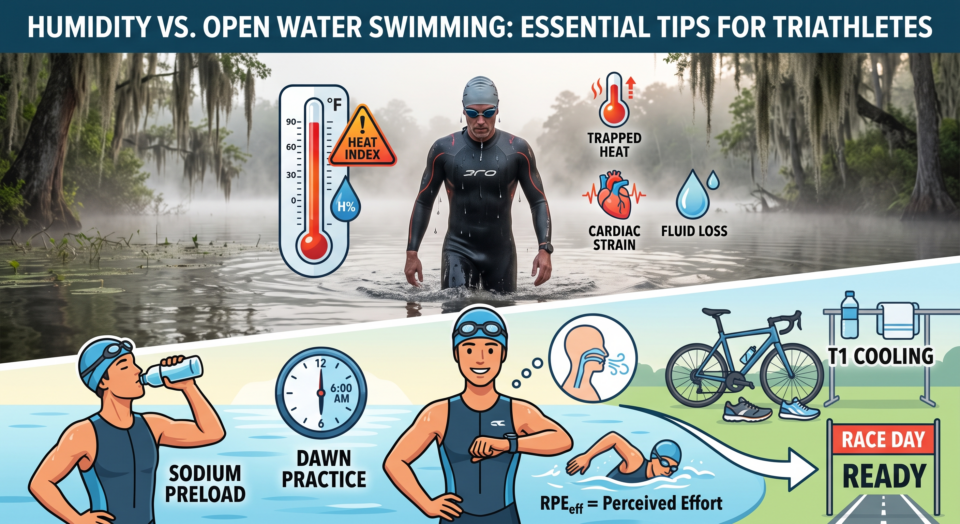
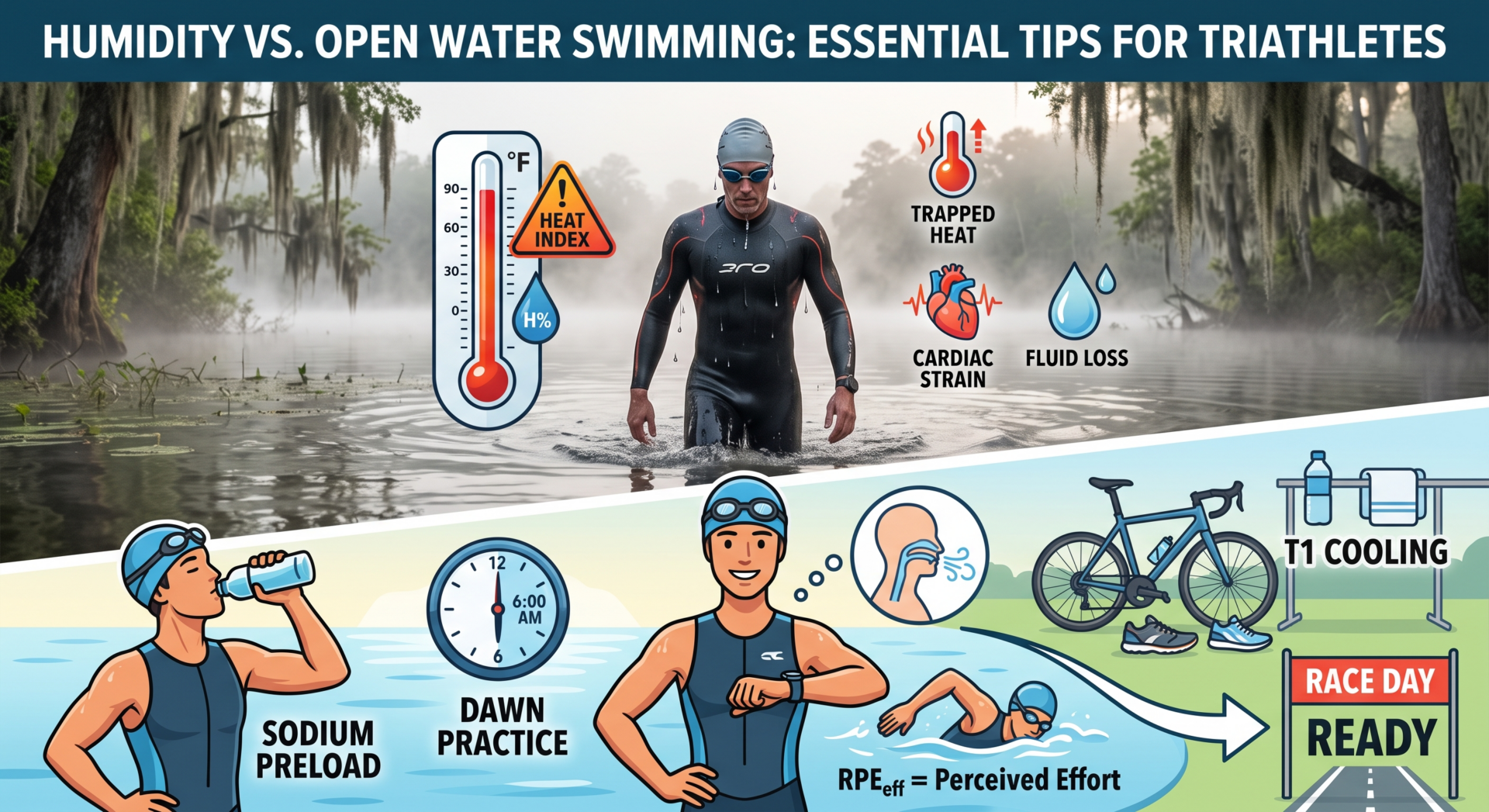
Warm water raises core temperature faster than most athletes expect during racing. The result? Increased cardiovascular strain, accelerated sweat loss, faster dehydration, and fatigue that builds earlier than your fitness level should allow. Unlike running or cycling – where airflow helps pull heat away from your body – swimming in warm water traps that heat with nowhere to go.
Regular warm-water training teaches your body to manage all of this. Effort control, hydration awareness, pacing stability – these skills only develop when you practice in conditions that replicate what race day actually feels like. Acclimation also sharpens your breathing control and mental calmness when your body temperature climbs. Gulf Coast racing demands both.
Early Morning and Dawn Swim Benefits
There’s a practical reason most Houston triathletes hit the water at dawn. Outdoor pools fill up fast by mid-morning – afternoons and evenings belong to school groups and leisure swimmers. Early sessions give you the lane, the quiet, and the cooler temperatures all at once.
The psychological benefit is just as real. Finishing a training session before most people have eaten breakfast sets a productive tone for the entire day. There’s also a recovery angle worth noting: swimming after a run or bike session helps flush out the legs and speeds up recovery.
Adapting Your Training Schedule to Heat
Heat acclimation takes time – typically 10-14 days of consistent exposure before your body learns to manage it efficiently. You can’t shortcut that window. What you can do is structure your training around it.
Schedule your hardest sessions for early morning or late evening when temperatures drop. Pull back your initial workout intensity and build it back gradually as your heat tolerance improves. Trying to push full effort in peak afternoon heat before you’ve acclimated is a fast path to poor sessions and slower adaptation.
Indoor Trainer Sessions for Cross-Training
Cap indoor trainer sessions at 60-75 minutes. Indoor environments make overheating dangerously easy – your sweat response goes into overdrive without natural airflow to offset it. Set up three fans directed at your face, front torso, and back before you start. That airflow isn’t comfort – it’s damage control.
High Humidity Workout Modifications
High humidity is particularly deceptive. Your sweat still forms – but it can’t evaporate properly, which means your body’s primary cooling system stops working effectively. The heat stays trapped.
Wear light-colored, loose-fitting moisture-wicking fabrics for any outdoor session. And on the most brutal Houston days? Get in the water. Swimming and water-based activities remain the safest training option in extreme heat because the water itself provides what the air cannot – a genuine cooling effect.
Race Week and Competition Day Tactics
Final Week Taper and Open Water Practice
Race week is not the time to squeeze in extra fitness. That work is done.
For IRONMAN 70.3 races, execute a 17-day taper with your last long run at 16-17 days out and your final long bike 10-11 days before race day. Keep swimming at normal volumes right through the Thursday before race week. During the final days, pull back hard – limit run efforts to brief, intense intervals under 30 seconds and keep pool work to sharp 75-yard sprints. Get your last open water session in at Twin Lakes or Sylvan Beach 5-7 days before competition. You want to maintain your feel for open water without piling up fatigue you’ll carry to the start line.
Hydration Protocol for Hot Conditions
Gulf Coast race day heat is relentless. Your hydration strategy needs to start long before the gun fires.
Begin preloading 2-3 hours before the start – drink 16-20 oz of water or electrolyte solution. Add another 5-10 oz roughly 15-30 minutes out. Once racing, target 14-27 oz of fluid per hour, adjusting based on conditions. Sodium becomes critical the moment your race pushes past two hours. Aim for 300-600 mg per hour, and heavy sweaters racing in extreme Gulf Coast heat may need to push that to 800-1,200 mg hourly. Underestimate sodium and you’ll feel it long before the finish line.
Pre-Race Warm-Up in High Temperatures
Here’s something most athletes get backwards – shorter races actually demand longer warm-ups, not the other way around.
For sprint and Olympic distances, block out 10-15 minutes of swimming with race-pace efforts during the second half of your warm-up. IRONMAN athletes need far less – 5-10 minutes of easy swimming with a few strong efforts is enough. High ambient temperatures change the equation. Shorter warm-ups protect your core temperature from climbing too early, preserving performance potential before you even hit the water.
Managing Anxiety and Mental Preparation
Pre-race nerves feel like a problem. They’re not. They’re your body doing exactly what it should.
Control your breathing first. Inhale slowly through your nose, exhale fully through your mouth – two minutes of this before the start settles your nervous system more than any pep talk. Then visualize your race swim in detail: smooth strokes, calm navigation through the course, a relaxed exit from the water. If anxiety still runs high at the start line, seed yourself slightly behind the faster swimmers. Give yourself space to find your rhythm before the chaos of the pack closes in.
Post-Swim Transition in Heat
Exiting the water at Twin Lakes or Sylvan Beach isn’t the moment to stop and catch your breath. Keep moving.
Stopping abruptly after the swim drops blood pressure fast and brings on dizziness precisely when you need to be sharp. Take short steps at a higher cadence as you move toward transition – your calf muscles pump blood back toward your heart, keeping circulation working in your favor. This simple habit sharpens your mental concentration through T1 and sets up better pacing decisions the moment you clip into the bike.
Key Takeaways
Houston triathlon swimming training isn’t easy. The warm water, the humidity, the choppy conditions at Sylvan Beach – none of it makes this straightforward. But that’s exactly what makes the preparation worth it.
Stay consistent with your pool sessions. Get out to Twin Lakes or Sylvan Beach regularly. Respect the heat and build your acclimation deliberately. Do those three things, and your swimming will improve – not dramatically overnight, but steadily and reliably in ways that show up on race day.
The swim leg doesn’t have to be the segment you survive. With the right triathlon swimming training approach built around Gulf Coast realities, it becomes the segment where you set the tone for everything that follows.
Trust your preparation. The work is already done before you hit the water.
Key Takeaways
Mastering triathlon swimming in Houston’s Gulf Coast climate requires strategic preparation for unique environmental challenges including extreme heat, high humidity, and warm water temperatures that demand specialized training approaches.
• Assess your swimming level first: Categorize yourself as Level 1 (25-50m continuous), Level 2 (400-800 yard intervals), or Level 3 (1000m+ sets) to build an appropriate training plan.
• Train at Houston-specific locations: Twin Lakes Scuba Park and Lake Longhorn require wetsuits or flotation devices; Sylvan Beach offers realistic choppy conditions for race preparation.
• Master pool-to-open-water transition: Practice no-wall turns, hypoxic breathing every 3-9 strokes, and sighting drills (head-up swimming) to simulate race conditions without pool advantages.
• Acclimate to heat within 10-14 days: Schedule intense workouts during early morning hours, reduce initial intensity, and practice in warm water to manage cardiovascular strain and dehydration.
• Execute proper race week taper: Complete your last long workouts 10-17 days out, maintain swimming volume until Thursday before race week, and limit final efforts to brief intervals under 30 seconds.
• Hydrate strategically for Gulf Coast racing: Preload 16-20 oz of fluids 2-3 hours before start, consume 14-27 oz per hour during racing, and intake 300-1,200 mg sodium hourly in extreme heat.
The combination of consistent pool training, regular open water practice, and Houston-specific heat adaptation strategies will transform your swimming from the most feared segment into a competitive advantage on race day.
FAQs
Q1. How long does it take a beginner to build swimming endurance for a triathlon? Most beginners can progress from swimming just 25 yards to completing 500 yards continuously within 4-6 weeks of consistent training (3 sessions per week). The breakthrough often happens suddenly—many swimmers report going from a 100-yard maximum to easily swimming 500 yards almost overnight once proper breathing technique and pacing click into place.
Q2. Do I need a swim coach to prepare for my first triathlon? While not absolutely required, working with a swim coach is highly beneficial for beginners. Swimming is extremely technical, and poor form creates unnecessary drag and exhaustion. Even a package of 4-5 lessons can provide enough foundational technique to practice independently. Many triathletes who started unable to swim 25 yards completed their first IRONMAN within 18 months after just a few coaching sessions.
Q3. What’s the best way to practice open water swimming skills in a pool? Simulate open water conditions by swimming long sets without touching the walls (flip at the T-mark 5 feet before the wall), practicing sighting drills by lifting your head every 4-6 strokes, and performing hypoxic breathing sets where you breathe every 3-9 strokes. Also practice 90-degree turns around imaginary buoys and group drafting with other swimmers to prepare for race-day pack swimming.
Q4. How should I adjust my triathlon training for hot and humid conditions? Heat acclimation takes 10-14 days of consistent exposure. Schedule intense workouts during early morning hours when temperatures are coolest, reduce initial workout intensity and gradually increase it, and practice in warm water to learn heat management. Wear moisture-wicking fabrics, use multiple fans during indoor sessions, and limit indoor trainer workouts to 60-75 minutes maximum to prevent overheating.
Q5. What should I do if I panic during my first open water swim? Practice safety strokes like backstroke and side stroke as rest positions if you become winded. Always wear a brightly colored swim buoy that can support your weight in an emergency. Control pre-race anxiety through breathing exercises (slow inhale through nose, full exhale through mouth) and position yourself slightly behind faster swimmers at the start. Remember that nervousness is normal and doesn’t indicate poor preparation.