No Pain No Gain or No Brain No Gain Guide for Triathletes
April 19, 2026
Lactate Testing: Why Runners Who Test Outperform Those Who Don’t
April 24, 2026
Remember that crushing feeling when Houston’s sticky air transforms your legs into concrete during mile 10? You’re battling more than just heat – you’re fighting a scientific phenomenon that can slow your pace by over a minute per mile.
Houston’s oppressive conditions create unique challenges for triathletes. The good news? Understanding how your body responds and implementing proven strategies can help you race effectively when the air feels thick enough to swim through.
• Start heat acclimatization 2-3 weeks before race day – Train for 60-75 minutes at 75-80% max heart rate in temperatures above 86°F to trigger physiological adaptations
• Adjust pacing by 3 seconds per mile slower for every 5°F above 65°F – Use heart rate and perceived exertion instead of pace targets in humid conditions
• Prioritize hydration over calories during races – Consume 21 ounces of fluid per 100 calories and include 500-700mg sodium per 32 ounces of hydration
• Use pre-cooling tactics before racing – Drink frozen sports drinks, apply ice towels to neck and thighs, and stay in shade to lower core temperature before starting
• Recognize heat illness warning signs immediately – Stop exercising if you experience confusion, coordination problems, or paradoxical chills despite high body temperature
Heat acclimatization produces lasting adaptations including 10-12% plasma volume increases and improved sweating efficiency. These changes help you perform better in both hot and cool conditions, making humidity training a valuable year-round strategy for Houston athletes.
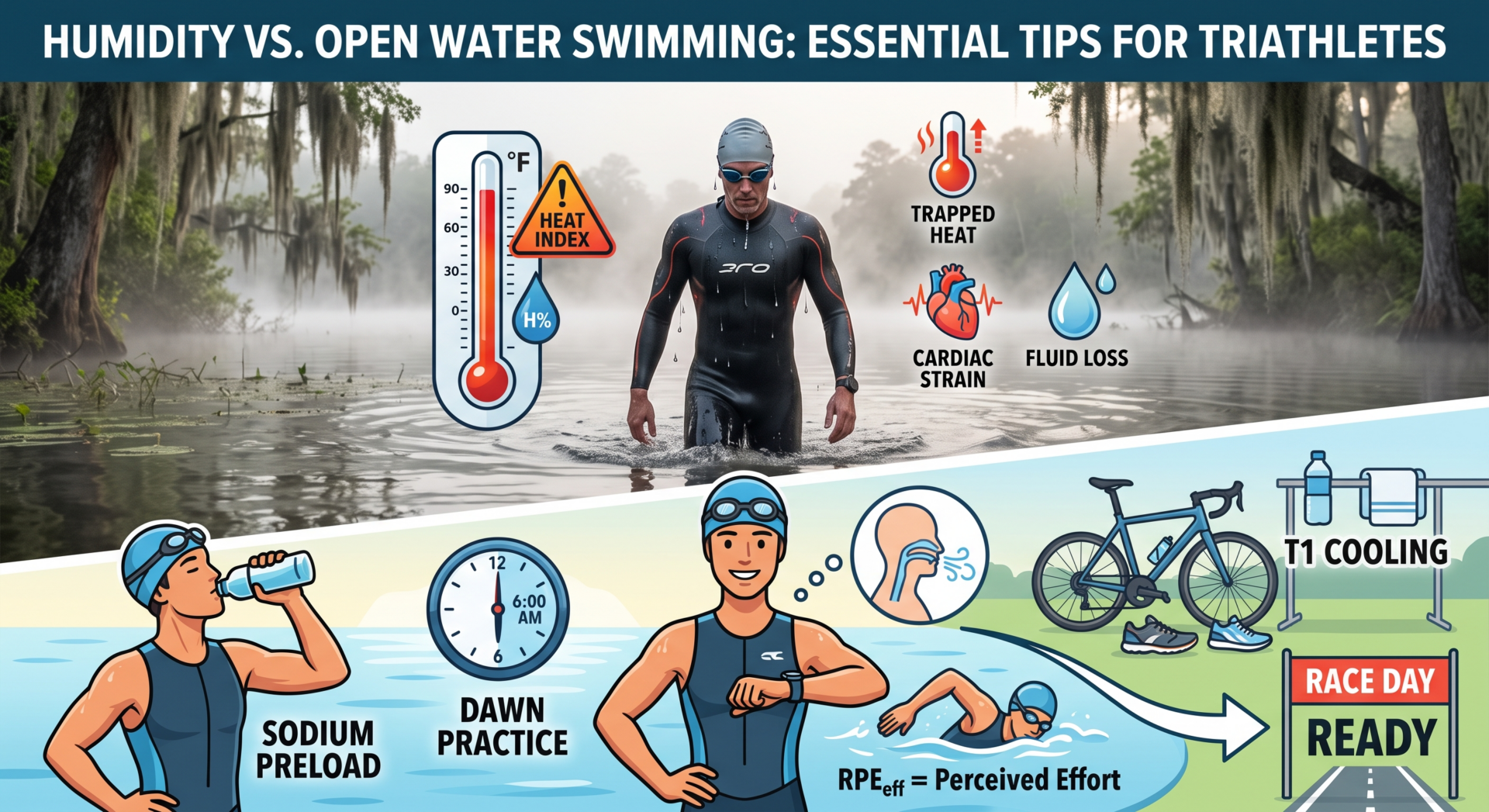
Have you noticed how the thick Gulf Coast air seems to squeeze every ounce of speed from your stride? The science explains why: humidity above 40% makes sweat evaporation difficult, and when it climbs to 70%, your perceived temperature jumps by several degrees. Hot and humid conditions notably increase your risk of dehydration and heat exhaustion. This guide breaks down how humidity affects your body during each discipline and provides proven strategies to help you race effectively in Houston’s challenging climate.
Houston’s Climate Challenge: What Makes This City Different for Triathletes
Houston’s unique climate creates the perfect storm for overheating
Ever wonder why that 80°F Houston morning feels like a furnace compared to the same temperature in Colorado? Houston sits near the Gulf Coast, creating a climate cocktail that goes beyond simple heat. Humidity matters more than temperature when it comes to overheating risk. You’ll face oppressively hot conditions combined with suffocating humidity levels that frequently approach 70% during peak training and racing months.
The city’s concrete jungle amplifies this challenge. Those concrete surfaces don’t just look hot – they radiate heat back at you, making outdoor workouts feel like training inside an oven. Your body must manage elevated air temperatures in the upper 90s, radiant heat from direct sun exposure, and minimal wind to assist cooling. Race day temperatures around 75°F might seem manageable until humidity levels transform the air into something you can practically drink.
Your body’s battle against Houston humidity
Your body generates roughly 800 watts of heat when you output just 200 watts of power. Think about that ratio. Your body operates at only 20% efficiency, meaning 80% of your energy becomes excess heat during a triathlon. Normally, you’d rely on multiple heat transfer pathways to stay cool, but when ambient temperatures rise, those temperature differences between your skin and surroundings shrink.
Houston’s humidity creates two distinct physiological problems that directly impact your race performance. Your core body temperature climbs faster than normal. Research shows humidity-induced performance decline reaches 3.4% during time trials. Your cardiovascular system also takes a beating as blood pools in your limbs, reducing blood flow to your heart and subsequently to working muscles.
The numbers tell a stark story. Your heart rate increases by approximately 1 beat per minute for each degree Celsius rise in air temperature. Warmer conditions push your skin temperature up by 0.5°C per degree of air temperature increase and boost sweat rate by 0.04 liters per hour per degree. Your body shifts from aerobic to anaerobic energy production, depleting muscle energy stores faster than you can replenish them.
Dehydration compounds every problem. Athletes lose between 2 to 8% of body weight during high-intensity exercise in hot conditions, and your gut simply cannot absorb fluids fast enough to match that loss rate. This dehydration decreases your VO2max, meaning your body uses oxygen less efficiently to produce energy.
The sweat trap that kills cooling efficiency
Here’s what many triathletes don’t realize: sweat itself doesn’t cool you. Evaporation does the actual cooling work. When humidity reaches 60%, your body’s thermoregulation capacity becomes substantially compromised. Athletes begin tiring more quickly once relative humidity hits this threshold.
Absolute humidity governs the evaporative rate, particularly at higher work rates and air temperatures. When air contains minimal moisture, a large gradient exists between your skin and the atmosphere, allowing sweat to evaporate efficiently. At 100% humidity, sweat cannot evaporate at all and merely drips off, carrying minimal heat away.
The heat index reveals the brutal truth. An 80°F day with 35% humidity feels like 80°F, but bump humidity to 70% and the heat index jumps to 83°F. At 90% humidity, that same 80°F day feels like 86°F.
Research on sweat droplet dynamics explains why Houston workouts feel so oppressive. At high humidity levels, sweat maintains a liquid phase residue on your skin rather than fully evaporating. The evaporation time for sweat droplets at 75% relative humidity doubles compared to lower humidity conditions. This reduced evaporative heat transfer elevates the heat index and impairs your thermoregulation capacity.
Your body attempts to compensate by increasing sweat rate in humid conditions by 20-30% compared to dry environments. This explains why you feel drenched during Houston workouts despite getting minimal cooling benefit.
When Your Body Fights Back: The Physical Toll of Houston’s Humidity
Core temperature regulation challenges
Remember that feeling when your internal thermostat seems completely broken during a humid race? Your core temperature can climb above 40°C during a triathlon in humid conditions, even at sprint distances. Research on World Cup triathletes revealed that 17 athletes exceeded this threshold, with two surpassing 41°C. Amateur athletes face similar risks, with one competitor recording a core temperature above 41°C despite racing at a lower intensity.
The dangerous part? Elevated humidity increases core temperature during fixed-intensity exercise while minimally affecting skin temperature or heart rate. Your internal heat builds without the usual warning signs. Mean body temperature rises significantly when relative humidity reaches 61% and 71% compared to 23% humidity conditions. At exhaustion, athletes in high humidity environments record core temperatures of 38.1°C to 38.3°C versus 37.7°C in lower humidity.
Your cardiovascular system pays the price. Heart rate during steady-state exercise jumps significantly in 61% and 71% humidity trials compared to 23% humidity. Stroke volume systematically declines as humidity rises, reaching significantly lower levels at 71% relative humidity. High skin temperature narrows the core-to-skin temperature gradient, resulting in greater heat storage accumulation. This reduced gradient leads to lower muscle power output as your body attempts to limit heat production.
Dehydration and electrolyte loss
Hot-humid exercise triggers fluid and electrolyte losses that derail your race performance. You’ll lose between 2.5% to 3.2% of body weight through sweat during extended efforts. Marathon runners experience plasma magnesium concentration drops of 20%, while osmolality increases by 1.7% to 4%. Plasma sodium rises by 1% to 3.5%, urea by 22% to 26%, and creatinine by 50% to 55%.
Hot environments make these imbalances worse. Plasma potassium elevation reaches 15% in humid conditions, with pronounced physiological responses in osmolality, sodium levels, and urine markers suggesting severe dehydration and kidney stress. Proteinuria affects 69% of marathon runners, while hematuria impacts 22%. Heavy sweating reduces your time for sodium and chloride reabsorption through sweat ducts, increasing electrolyte concentration in sweat itself.
Effects on each triathlon discipline
Cycling performance suffers severely from heat and humidity. Time trial performance drops 3.4% when humidity increases. The combination of heat stress and dehydration reduces aerobic exercise performance by 7% to 60% during efforts exceeding 90 minutes.
Humidity and running performance decline
Running takes the hardest hit from Houston’s oppressive conditions. Marathon performance decreases 2% to 10% as wet bulb globe temperature increases from 10°C to 25°C. Time to exhaustion declines significantly at 61% and 71% relative humidity compared to 23%. Runners completing a 6-kilometer test in hot-humid environments take significantly longer than those in warm conditions.
The numbers tell the story. At 80°F with 30% humidity, average running pace measures 9:19 per mile. Increase humidity to 70% at the same temperature, and pace slows to 10:14 per mile. At 90% humidity and higher, pace drops to 11:07 per mile.
Heat Training Protocols: Turn Houston’s Climate Into Your Secret Weapon
Heat acclimatization unlocks hidden performance gains
Here’s what most triathletes don’t realize: heat training produces adaptations that boost your performance in cool conditions too. Your body transforms when you deliberately stress it with hot environments. Plasma volume increases by 10-12%, which maintains stroke volume and allows you to store more heat with smaller temperature gains. Your sweating response becomes more efficient, starting earlier and producing higher volumes.
Heat training teaches your cells to tolerate higher temperatures through heat shock protein release, which significantly reduces your risk of exertional heat illness. Your brain rewires itself to feel more comfortable in heat, with the thermoregulation center becoming more responsive.
The key? Elevating your core body temperature during training sessions. Target temperatures above 30°C (86°F) and exercise for 60-75 minutes at 75-80% of maximum heart rate. Research suggests maintaining core temperature at 38.5°C for approximately 60 minutes provides the minimal thermal stimulus for effective adaptation.
Indoor heat training when Houston weather turns extreme
Skip the outdoor oven when temperatures become dangerous. Indoor environments offer controlled conditions for humidity training. Wear additional layers during workouts to restrict heat loss and elevate core temperature. Winter gear, including hats and jackets, works effectively on trainers or treadmills. Skip fans entirely or reduce airflow to amplify thermal strain.
Passive heat exposure extends your thermal stress following outdoor workouts. Hot water immersion at 40°C (104°F) for 30-60 minutes provides effective stimulus without additional training volume. Sauna sessions work similarly, though you’ll need 20-30 minutes to achieve comparable effects. These passive methods prove particularly valuable during taper periods when you want heat stimulus without training load.
Timing matters for heat adaptation
Most adaptations develop within 7-14 days of consistent heat exposure. Heart rate reductions appear within 4-5 days and complete by day seven. Plasma volume peaks after one week. Plan for at least 10 consecutive days of 90-minute heat exposures when starting from baseline.
Start your protocol 2-3 weeks before Houston race day. Athletes already heat-adapted need only 3-4 sessions starting around 10 days out. Without recent adaptation, complete at least 10 sessions within 14 days, beginning approximately 21 days before your event.
Heat adaptations decay at 2.5% per day without exposure. After two weeks without heat training, you’ll lose roughly 35% of cardiovascular gains.
Build your heat tolerance progressively
New athletes should limit initial exposure to 20% of target duration on day one, increasing by 20% daily. Athletes with recent heat experience can begin at 50% exposure, progressing to 60% on day two, 80% on day three, and full duration by day four.
Monitor your response carefully. Reduce training intensity during heat blocks by approximately 20% to account for added stress. Maintain proper hydration and increase sodium intake during initial days. Following an initial 5-session block, maintenance doses of 1-2 heat sessions weekly preserve your adaptations.
Race Day Tactics: Mastering Houston’s Heat When It Counts
Pre-race cooling strategies that actually work
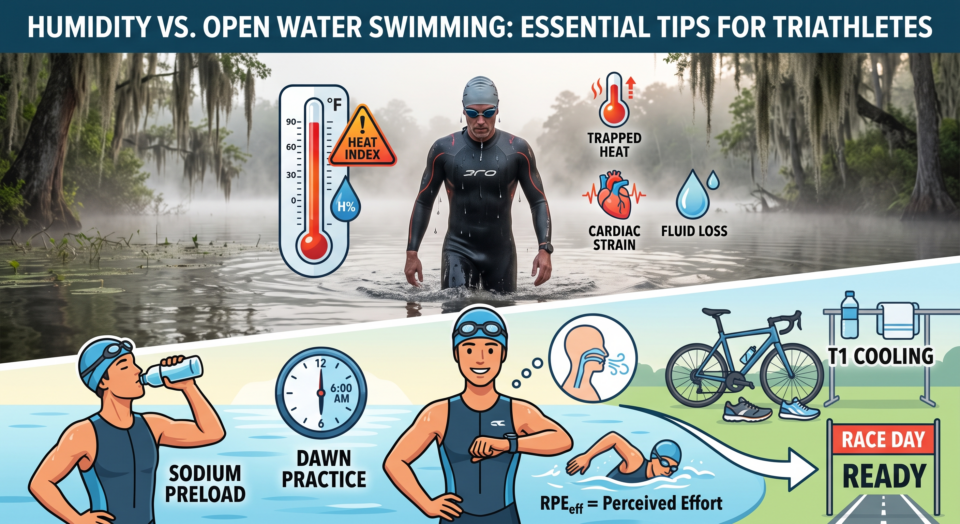
Drink 16-20 ounces of fluid 2-3 hours before your race start. Your core temperature determines how long you can maintain race pace before overheating becomes a limiting factor. Pre-cooling extends this window significantly.
Freeze a cup of your sports drink 10-20 minutes before the race and drink it as a slushy. The cold liquid drops your internal temperature before you even start. Wet hand towels, freeze them overnight, and place them on your neck, head, back, and between your thighs 10-15 minutes before starting. These pulse points cool your blood efficiently. Stay in shaded or air-conditioned areas before the start – every degree matters when you’re already fighting Houston’s oppressive conditions.
Pace adjustments that save your race
Here’s the math that matters: for every 5 degrees over 65°F, slow your goal pace by 3 seconds per mile. At 95°F, that’s six increments. You’ll need an 18-second per mile reduction.
Don’t rely on pace alone. Your watch can’t measure heat stress. Use heart rate, power, and perceived exertion to gauge effort. Expect your heart rate to climb 5-7 beats higher than normal in hot conditions. Reduce bike power output by 5-10% on scorching days.
Hydration over calories: why this matters
Dehydration kills performance faster than running out of fuel. Consume 21 ounces of fluid for every 100 calories. Your gut struggles to process solid foods as temperature climbs. Shift toward liquid calories during humid conditions.
Heavy sweaters need up to 1200mg of sodium per hour, though most athletes do well with 500-700mg per 32 ounces of hydration. Set reminder alarms to drink – your thirst sensation fades during long efforts.
Equipment choices for heat management
White clothing reflects sunlight instead of absorbing it. Your bike needs multiple bottle cages for extra fluids. Carry one more bottle than normal – you might need additional hydration or lose a primary bottle.
Many companies make clothing with pockets you can fill with ice at aid stations. Wear a hat rather than a visor to hold ice. Cooling sleeves protect your arms from sun while retaining water.
Aid station execution
Cold water at aid stations beats the warm liquid in your bottles. Water heats up on course, making those station stops critical. Slow down through bike aid stations to grab everything you need.
Put ice in your sports bra, hat, neck wrap, and hands. Target pulse points: femoral artery, head, and palms. Cool the glabrous skin zones on your palms, feet, and forehead. Discard sponges after squeezing them out – they trap heat once the cooling effect ends.
Mental tactics for oppressive conditions
Accept the heat instead of fighting it. Reframe your thinking from “this heat is unbearable” to “this separates the prepared from the unprepared”. Break the race into smaller segments. Focus on reaching the next aid station instead of obsessing over the finish line.
Listen to your body. Scale expectations when heat stress becomes dangerous. Your safety matters more than any finish time.
Houston’s Year-Round Heat Reality: Smart Training When Humidity Won’t Quit
Timing your workouts around Houston’s brutal conditions
Remember that 6 AM run that felt like swimming through soup? Houston’s humid months demand strategic workout timing. Schedule workouts early in the morning or late at night to avoid peak heat. Split long runs into two shorter sessions rather than one extended effort in oppressive conditions. Run in shaded areas whenever possible, as direct sun exposure increases skin temperature substantially above air temperature. Concrete surfaces radiate heat back at you, making flat trails, grass, and sand better options.
Weather stress at mile 4 can slow you by 36 seconds per mile compared to cooler conditions. Use heart rate and perceived exertion rather than pace targets during humid months. Indoor training on a treadmill provides controlled conditions when outdoor humidity becomes dangerous.
Heat illness signs that demand immediate action
Your body sends clear distress signals when heat becomes dangerous. Monitor for fast heartbeat, rapid breathing, fatigue beyond normal levels, dizziness, heavy sweating, headache, nausea, muscle cramps, and pale skin. Coordination problems and fainting signal severe heat stress.
Stop running immediately if you experience confusion, disorientation, vision problems, or paradoxical chills despite high body temperature. Heat stroke occurs when core temperature rises to 106°F or higher within 10-15 minutes. Without emergency treatment, heat stroke causes permanent disability or death.
Recovery tactics that accelerate adaptation
Rehydrate with 150% of fluid weight lost during exercise. Drink consistently over several hours rather than consuming large volumes immediately. Local heat therapy accelerates muscle recovery by enhancing blood flow, substrate delivery, and waste removal. Post-workout sauna or hot bath sessions promote glycogen resynthesis and reduce delayed-onset muscle soreness when combined with proper nutrition.
Conclusion
Houston’s humidity presents a formidable challenge, but you can master it with proper preparation. Heat acclimatization training produces measurable physiological adaptations that improve your performance in both hot and cooler conditions. Start your heat training protocol 2-3 weeks before race day, focusing on elevating core temperature during controlled sessions. On race day, combine pre-cooling tactics with conservative pacing and systematic hydration strategies. Listen to your body and adjust your expectations accordingly, as heat illness warning signs demand immediate attention. When you respect the science behind humidity’s effects and implement proven training strategies, you’ll transform Houston’s oppressive climate from an obstacle into an opportunity to demonstrate your mental toughness and physical preparation.
FAQs
Q1. How does high humidity impact athletic performance during triathlons? High humidity significantly impairs athletic performance by preventing efficient sweat evaporation, which is your body’s primary cooling mechanism. This leads to increased core body temperature and accelerated dehydration. Research shows that humidity can cause performance declines of 3-4% during time trials, with running pace slowing by over a minute per mile when humidity exceeds 90%. Your cardiovascular system also experiences greater strain as your heart rate increases and stroke volume decreases in humid conditions.
Q2. What makes Houston’s climate particularly challenging for triathlon training? Houston’s location near the Gulf Coast creates a unique combination of high temperatures and humidity levels that frequently reach 70% or higher during peak training months. The city’s concrete surfaces amplify heat stress by radiating additional warmth. This creates “severe heat stress” conditions where the heat index can make an 80°F day feel like 86°F or higher, making it one of the most demanding environments for endurance training in the United States.
Q3. At what humidity level should I avoid running outdoors? You should avoid running outside when the heat index exceeds 98.6°F and humidity is above 70-80%. At these levels, the air’s moisture content prevents sweat from evaporating off your skin, which can cause your body to overheat rapidly. When humidity reaches 60%, your body’s thermoregulation capacity becomes substantially compromised, and athletes begin tiring more quickly.
Q4. How long does it take to become heat-acclimated for racing in humid conditions? Most heat adaptations develop within 7-14 days of consistent heat exposure. For optimal results, plan for at least 10 consecutive days of 90-minute heat training sessions. If you’re preparing for a Houston race, start your heat acclimatization protocol 2-3 weeks before race day. Athletes who are already heat-adapted need only 3-4 sessions starting around 10 days out to maintain their adaptations.
Q5. What are the best times to train outdoors during Houston’s humid summer months? Schedule your workouts early in the morning (starting between 3:30-6:00 AM) or late at night to avoid peak heat and humidity. Many Houston triathletes start long bike rides before sunrise and complete long runs after sunset when the dew point and humidity are lower. If training during daylight hours, seek shaded areas and consider splitting longer sessions into two shorter workouts to minimize heat exposure.