
How to Create Your Perfect Triathlon Nutrition Plan: From Training to Race Day
July 11, 2025
Why Elite Ultra Runners Rely on Lactate Testing: Science-Backed
July 13, 2025
Water temperatures between 10-20°C (50-68°F) offer ideal conditions for triathlon swim technique practice. Never spend more than a few minutes in water below 5°C (41°F) – hypothermia becomes a real threat at these temperatures.
Swimming intimidates many triathletes more than any other discipline. The tension builds before you even hit the water, making every stroke feel like a battle. Most triathletes come from running or cycling backgrounds, adding swimming as their final piece of the puzzle. Even seasoned athletes need dedicated open water training before each race season kicks off.
Proper swim training separates the strugglers from the successful. An IRONMAN Masters division champion put it perfectly: “You can’t win the race in the swim, but you can lose it there.” A skilled triathlon swim coach makes the difference when you’re ready to move from pool lanes to open water racing conditions. Learning ironman swim techniques for beginners is essential for building the confidence needed to tackle open water challenges. Focusing on stroke efficiency, breathing patterns, and sighting techniques can significantly enhance performance. By incorporating these strategies into your training regimen, you’ll set a solid foundation for race day success. mastering ironman swim techniques involves not just physical training, but also mental preparation. Visualization and mental rehearsal can help athletes overcome the psychological barriers of swimming in open water. Emphasizing these aspects alongside technical skills will give you a comprehensive approach to triathlon success.
Don’t worry – you’re not alone in this challenge. Many triathletes face the same fears and technical hurdles when building their swim skills.
This guide takes you from foundational pool work to confident open water racing. Ready to transform your swim leg from weakness to strength?
Start in the Pool: Build Technique and Confidence
The pool provides your foundation for triathlon swim success. Master these fundamentals first, and your open water performance will follow naturally.
Focus on stroke efficiency and breathing
Here’s what separates efficient swimmers from the rest: proper breathing technique. Many triathletes sabotage their performance by holding their breath underwater, creating an irregular pattern that leads to oxygen debt.
Exhale smoothly through your nose and mouth while your face stays in the water – aim for about half your lung capacity. This continuous exhalation prevents carbon dioxide buildup that makes swimmers feel desperate for air.
Time your breathing with precision. Take a small, relaxed sip of air as your head and body roll to the side on each stroke cycle. This pattern of ventilating your lungs every stroke cycle ensures steady oxygen supply. Bilateral breathing adds balance to your stroke and prepares you for open water conditions where breathing to only one side might not work.
Use drills to improve form and balance
Stroke drills isolate specific elements, allowing you to focus on one improvement at a time. These four drills deliver the biggest impact:
- Fingertip Drag: Brush your fingertips along the water’s surface during recovery to maintain high elbow position and extend your reach.
- Fists: Swim with clenched fists to feel how your forearms contribute to propulsion. This drill reveals the power of your pulling hand.
- Catch-Up: Touch your recovery arm to your extended arm before beginning the opposite pull, maximizing stroke length.
- Zipper Drill: Run your recovery arm’s thumb from hip to armpit before entering the water, improving high-elbow recovery and body rotation.
Follow this pattern: drill/swim/drill/swim. This approach integrates each improvement into your full stroke immediately.
Incorporate interval sets for endurance
Interval training provides structure and maintains focus throughout your session. Swimming shorter distances allows you to hold good technique for each interval, take a brief rest, reset, and repeat with proper form. Quality beats quantity every time—focused 45-60 minute sessions outperform endless swimming.
Structure every session consistently: warm-up (5-10 minutes easy swimming), pre-set (technique drills), main set (workout focus), and cool-down (3-5 minutes relaxed swimming). Different speeds teach you how much effort changes pace while developing race day gears.
Track progress with stroke count and pace
Stroke count reveals efficiency like no other metric—fewer strokes per lap means more efficient strokes. Most triathletes track speed but ignore stroke count. Schedule a swim stroke analysis and dial in your stoke to identify improvement opportunities.
Your stroke count serves dual purposes: progress indicator and daily technique check. Rising counts during a session or week signal deteriorating technique that needs attention. Consistent stroke count typically indicates steady pace and efficient technique.
Keep a simple training log with main set details, speed, stroke count, and perceived effort. This practice commits training to memory and creates a valuable improvement record—taking just 2-3 minutes of your time. Systematic tracking reveals patterns and guides appropriate adjustments.
Translate Pool Skills to Open Water
Pool perfection doesn’t guarantee open water success. The controlled environment that builds your foundation becomes a limitation when race day arrives with choppy waters, crowded fields, and zero lane lines to guide you.
Simulate open water in the pool
Early morning pool sessions offer the coldest water temperatures, mimicking natural conditions you’ll face on race day. Training with friends creates valuable turbulence and wave action similar to race environments. Choppier water demands more strokes and greater stamina.
Lane ropes provide artificial guidance that disappears in open water. Remove them when permitted to force straight-line swimming without visual cues. Pull buoys become valuable training tools, helping you practice proper breathing with aligned legs while strengthening stroke mechanics.
Olympic Coach Olav Aleksander Bu emphasizes real-time feedback during swimming to improve efficiency and consistency, ultimately enhancing performance. This mirrors cycling and running training, where immediate data feedback drives improvements.
Practice sighting and swimming without walls
Sighting separates pool swimmers from open water athletes. Brief forward glances for navigation require specific technique development without sacrificing speed. Master these pool-based drills:
- Tarzan Swim: Swim entire pool lengths with your head above water, focusing on arched back position and body alignment
- Where’s Waldo: Use proper sighting technique to locate your coach on the pool deck during single laps
- Blind Swimming: Swim with closed eyes in empty lanes, noting which lane line you contact most often to identify natural drift patterns
Pool sighting practice should include lifting your head twice during each length for sets of 4 x 100s. This controlled environment perfects body position before attempting open water navigation.
The “No Walls” drill simulates open water by turning around at the “T” on the pool bottom without touching the wall. Challenging but essential for open water preparation.
Use stroke count or time-based intervals
Distance-based pool workouts don’t translate directly to open water training. Convert sets to time or stroke count measurements for effective open water preparation.
Time-based intervals require calculating your average 100-yard/meter pace from pool swimming, then adding 5-10 seconds to account for missing walls. This method works best for intervals of 200 yards or more. Stroke-count intervals involve counting strokes across the pool, then multiplying accordingly (20 strokes across the pool equals approximately 50 yards at 40 strokes). This approach suits intervals under 200 yards.
Train with a triathlon swim coach for feedback
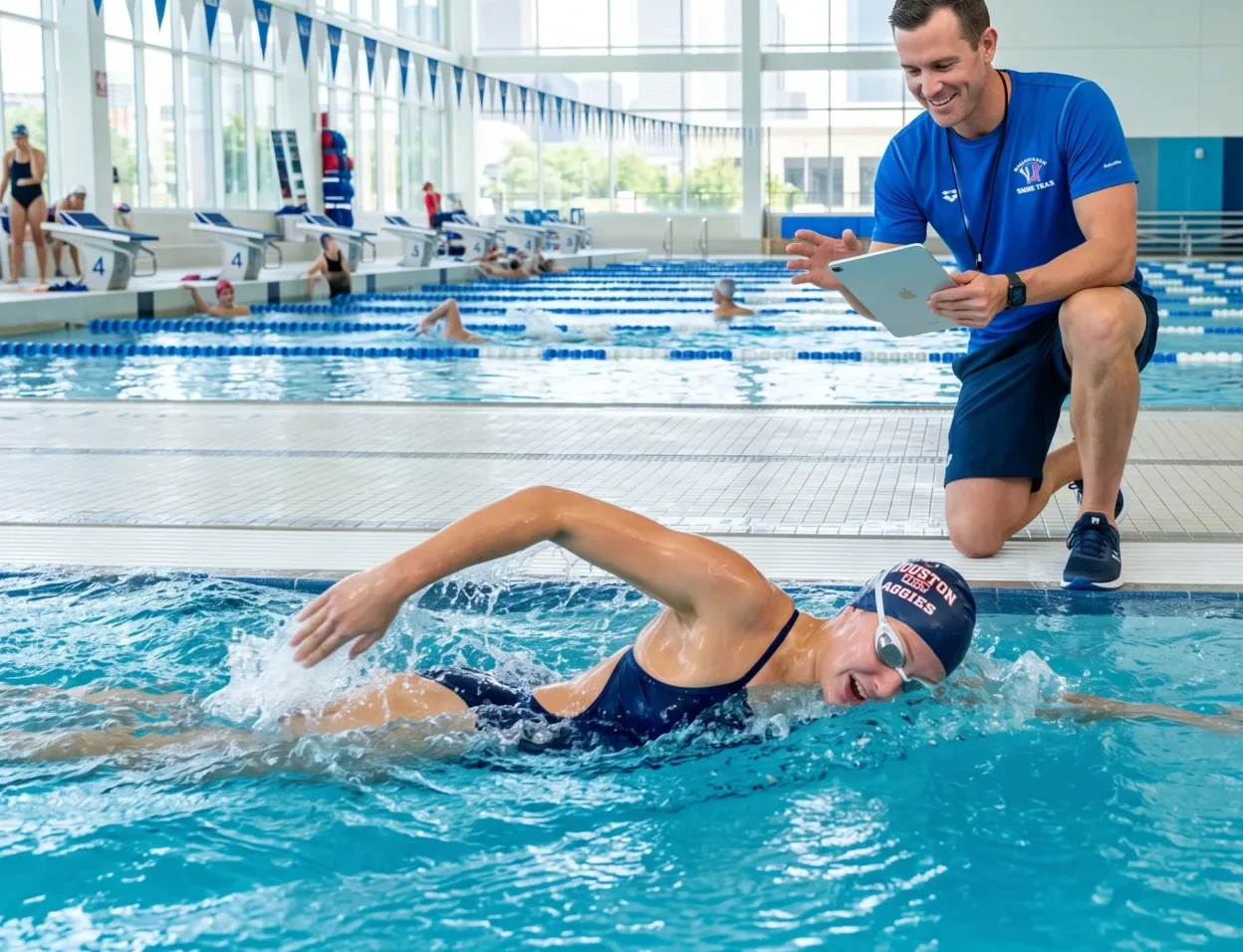
Specialized triathlon swim coaches provide invaluable real-time technique feedback. Schedule a swim stroke analysis and dial in your stoke before race day to identify specific improvement areas.
Olympic coaches emphasize athletes seeing efficiency data while swimming, not just afterward. Real-time observation of pace, stroke rate, and distance per stroke creates better connections between metrics and water feel.
The ultimate goal? Finding your optimal stroke-to-pace ratio for given effort levels, increasing efficiency and conserving energy for the bike and run portions of your triathlon.
Essential Drills for Open Water Readiness
Have you ever found yourself zigzagging across a lake during a race, adding precious minutes to your swim time? Open water drills separate confident swimmers from those who struggle to stay on course when the pool walls disappear.
These focused exercises prepare you for the chaos of race day. The difference between smooth navigation and panicked swimming often comes down to drill work you do months before your event.
Breathing and hypoxic drills
Panic breathing destroys more swims than poor technique. Trickle breathing becomes your secret weapon—continuously exhaling slowly through your nose and mouth when your face is underwater. This prevents dangerous CO2 buildup while teaching you to manage oxygen more efficiently.
Try this progressive challenge: swim 50m breathing every 3rd stroke, followed by 50m every 5th stroke, finishing with 50m every 7th stroke. Maintain steady exhalation underwater instead of holding your breath. Beginners benefit from the Rotisserie Kick drill—slowly rotate 360 degrees while kicking in streamline position.
Remember that controlled breathing beats breath-holding every time. Your goal is efficiency, not suffering.
Sighting and navigation practice
Swimming in a straight line seems simple until you try it without lane ropes. The Tarzan Swim (swimming with your head above water) strengthens your neck and back muscles needed for sighting. The Crocodile Eyes technique involves lifting just your eyes above the waterline—conserving energy compared to lifting your whole head.
Start with these focused drills: swim 10-20 strokes with your head out of water, looking at a fixed point; gradually decrease these “head-up” strokes until you’re effectively sighting with minimal form disruption. The Blind Swimming test reveals your natural drift pattern—swim 10-15 strokes with closed eyes, then check which direction you’ve drifted.
Most swimmers discover they naturally veer to one side. Knowing your tendency helps you correct course before it becomes a problem.
Buoy turn and start drills
Buoy turns can make or break your race position. Master the Rudder Turn by extending your arm closest to the buoy straight ahead as you approach, using it as a steering rudder while stroking with your opposite arm. Advanced swimmers use the Corkscrew Turn—take a hard stroke with the arm nearest the buoy, flip onto your back, execute one backstroke stroke, then corkscrew back to front-crawl position.
Practice starting drills by running into knee-deep water, transitioning to high-knee running, performing dolphin dives before swimming hard for 15-30 seconds. Repeat 5-6 times, ideally with others to simulate race conditions.
The first 30 seconds of your swim often determine your race position. Make them count.
Pick-up speed drills for passing
Can you accelerate when surrounded by other swimmers? The Pick-It-Up Drill improves your capacity to change pace: swim 25 strokes easy followed by 25 strokes at race pace. Extend the fast portions (25-50-75-100) while maintaining 25 easy strokes between efforts.
Group training becomes essential here. Practice the Diamond Drill where swimmers maintain a diamond formation while exchanging positions—teaching quick position changes and adaptability crucial for passing competitors. Line up with training partners and practice sprinting to overtake the group, simulating race passing scenarios.
Your ability to surge past other swimmers when it matters most separates good swimmers from great race results.
Prepare for Race-Day Conditions
Race day conditions separate the prepared from the panicked. Strategic practice under realistic circumstances pays dividends when the starting horn sounds.
Practice starts from land and water
Beach starts demand specific muscle memory—run into water until knee-deep, execute dolphin dives, then swim hard for 30 seconds. Repeat this sequence 5-6 times during training sessions. Water starts require different preparation. Practice treading water and standing positions until both feel natural.
Positioning strategy matters more than most athletes realize. Strong swimmers earn front-row starts, while beginners should position themselves to the side or behind faster competitors. Wave starts versus mass starts require different tactical approaches—understanding the race format determines optimal positioning.
Train in different weather and water types
Cold water shock can destroy months of preparation in seconds. Practice in your actual race venue beforehand to minimize this physiological response. Water temperature variations, tides, currents, and choppy conditions each present unique challenges that demand mental and physical adaptation.
Cold water preparation follows a progressive approach: start with short immersions, gradually extending exposure time as your body adapts. This methodical conditioning prevents the shock that derails many unprepared athletes.
Get used to swimming in a crowd
Contact happens during triathlon swims—arms collide, feet kick, and occasionally someone swims directly over you. Staying calm and continuing your stroke rhythm becomes crucial. Practice with training partners who create deliberate turbulence around you.
Strategic positioning at the start line can save significant energy. When the first turn goes left, start on the right side to avoid getting squeezed at buoys. This placement might add distance but prevents the energy drain of fighting through crowds.
Simulate transitions to bike leg
The horizontal-to-vertical transition creates disorientation for many athletes. Practice removing your cap and goggles while running, or work on wetsuit removal while moving. Olympic coaches recommend leaving bike shoes attached to pedals for faster transitions—practice this technique until it becomes automatic.
Increasing your kick rate during the final 100 meters of swimming redistributes blood flow to your legs, preparing them for the bike portion. This small adjustment can prevent the wobbly-leg sensation that costs precious seconds in transition.
Gear and Safety Essentials
Here’s a startling fact: improperly fitted gear causes more race day disasters than poor training. Your wetsuit, goggles, and safety equipment can make or break your triathlon swim performance.
Wetsuit and swimwear considerations
Water temperature decides your wetsuit choice. Temperatures under 76.28°F (24.6°C) generally require wetsuit use. Triathlon-specific wetsuits beat surfing or diving varieties every time – they’re built for flexibility and speed.
Smart design matters. Thicker neoprene (4-5mm) in the legs provides buoyancy while thinner material (1.5-2mm) around shoulders allows unrestricted arm movement.
Fit trumps everything else. Your wetsuit should feel snug without restricting your breathing or stroke mechanics. Too loose fills with water and slows you down. Too tight restricts movement and creates painful chafing.
Care extends your wetsuit’s life. Rinse with fresh water after each use, hang away from direct sunlight, and store flat or on a wide hanger. This simple routine prevents expensive replacements.
Goggles for visibility and comfort
Open water demands different goggle features than pool swimming. Wider, curved lenses increase peripheral vision – essential for spotting buoys and avoiding collisions.
Choose lens color strategically. Mirrored or polarized options reduce glare in bright conditions, while photochromatic lenses automatically adjust to changing light.
Fit matters more than fancy features. Even the most advanced goggles become useless if they leak. Test them by pressing gently against your eyes without the strap – they should create a slight vacuum seal without painful pressure.
Safety buoy and visibility gear
High-visibility equipment dramatically reduces accident risks in shared waterways. Tow floats – bright, inflatable buoys attached at your waist – make you visible to boaters while adding minimal drag. Many models double as dry storage for valuables.
Bright swim caps (neon orange or green) enhance visibility by contrasting with natural water features. For cold water swimming, neoprene caps provide additional warmth without compromising safety.
Check water quality and local rules
Water quality directly impacts your health. Recreational swimming increases risks of gastrointestinal illness, respiratory problems, and skin infections. Check local health department reports before swimming, especially after rainfall when contaminant levels spike.
Avoid water bodies with visible algae blooms – they may contain dangerous neurotoxins. Most triathlon governing bodies require water testing for E.coli, Enterococci, and blue-green algae before events. Understanding local regulations ensures both safety and competition eligibility – some venues mandate specific equipment like wetsuits.
Don’t let gear failures derail months of training. Proper equipment selection and maintenance keeps you safe and competitive.
Conclusion
Swimming efficiently saves energy for the bike and run portions of your race. The structured approach outlined here—building fundamentals in the pool before tackling open water challenges—creates steady, confident progress.
Your consistent drill practice pays dividends on race day. Breathing control, sighting accuracy, and efficient turns become second nature through repetition. Race condition simulations prepare you mentally and physically for mass starts and unpredictable open water environments.
Equipment selection plays a crucial role in performance and safety. The right wetsuit, properly fitted goggles, and high-visibility gear enhance your swimming experience while protecting you from potential hazards. Always prioritize safety by checking water conditions and following local regulations before entering any body of water.
Even experienced triathletes continually refine their swim technique. Progress happens gradually—small improvements in efficiency translate to significant time savings and energy conservation. Track your metrics, work with qualified coaches when possible, and remain patient with your development. Incorporating effective swim techniques for triathlon success is crucial for enhancing your overall performance. Focus on aspects such as stroke efficiency, breathing patterns, and body position in the water to maximize your potential. Regular practice and structured drills can help solidify these techniques, paving the way for improved race times. For those just starting their journey, mastering freestyle swimming techniques for beginners can provide a solid foundation for future growth. Understanding the basics makes it easier to build on more advanced methods later. Regular feedback and practice will not only enhance your comfort in the water but also instill confidence that translates to better overall performance.
Your swimming abilities will improve with dedicated practice of these techniques. The water leg of your triathlon no longer needs to be a weakness—it can become a strength that sets you up for success throughout the entire race.
Time to make swimming your secret weapon rather than your biggest worry.
Key Takeaways
Master your triathlon swim technique by building a solid foundation in the pool before tackling open water challenges, focusing on efficiency over speed to conserve energy for the bike and run portions.
• Build technique fundamentals in the pool first – focus on stroke efficiency, breathing patterns, and essential drills before attempting open water swimming • Practice open water-specific skills like sighting, crowd swimming, and race starts to prepare for actual competition conditions
• Use proper gear strategically – well-fitted wetsuits, visibility equipment, and appropriate goggles enhance both performance and safety • Track your progress through stroke count and pace metrics rather than just distance to measure true swimming efficiency • Simulate race conditions during training including transitions, weather variations, and swimming with others to build confidence
Quality technique beats quantity every time – focused 45-60 minute sessions with structured drills and intervals will improve your swimming more effectively than endless laps. Remember, you can’t win the race in the swim, but you can certainly lose it there, making proper preparation essential for triathlon success.
FAQs
Q1. How can I improve my triathlon swim technique in the pool? Focus on stroke efficiency and breathing, use drills to improve form, incorporate interval sets for endurance, and track progress with stroke count and pace. Quality technique practice in 45-60 minute focused sessions is more effective than endless laps.
Q2. What are some essential open water swimming drills for triathletes? Key drills include breathing and hypoxic exercises, sighting and navigation practice, buoy turn drills, and pick-up speed drills for passing. These help prepare you for the unique challenges of open water racing.
Q3. How should I prepare for race day swimming conditions? Practice starts from both land and water, train in different weather and water types, get used to swimming in a crowd, and simulate transitions to the bike leg. This helps you adapt to real race scenarios and minimize surprises on competition day.
Q4. What gear is essential for triathlon swimming? Essential gear includes a well-fitted wetsuit (for colder waters), comfortable goggles with wide lenses for better visibility, and safety equipment like high-visibility swim caps and tow floats. Always ensure your gear is appropriate for the specific race conditions.
Q5. How can I transition from pool swimming to open water for triathlons? Start by simulating open water conditions in the pool, practice sighting and swimming without walls, use stroke count or time-based intervals instead of distance, and consider working with a triathlon swim coach for personalized feedback on your technique.