
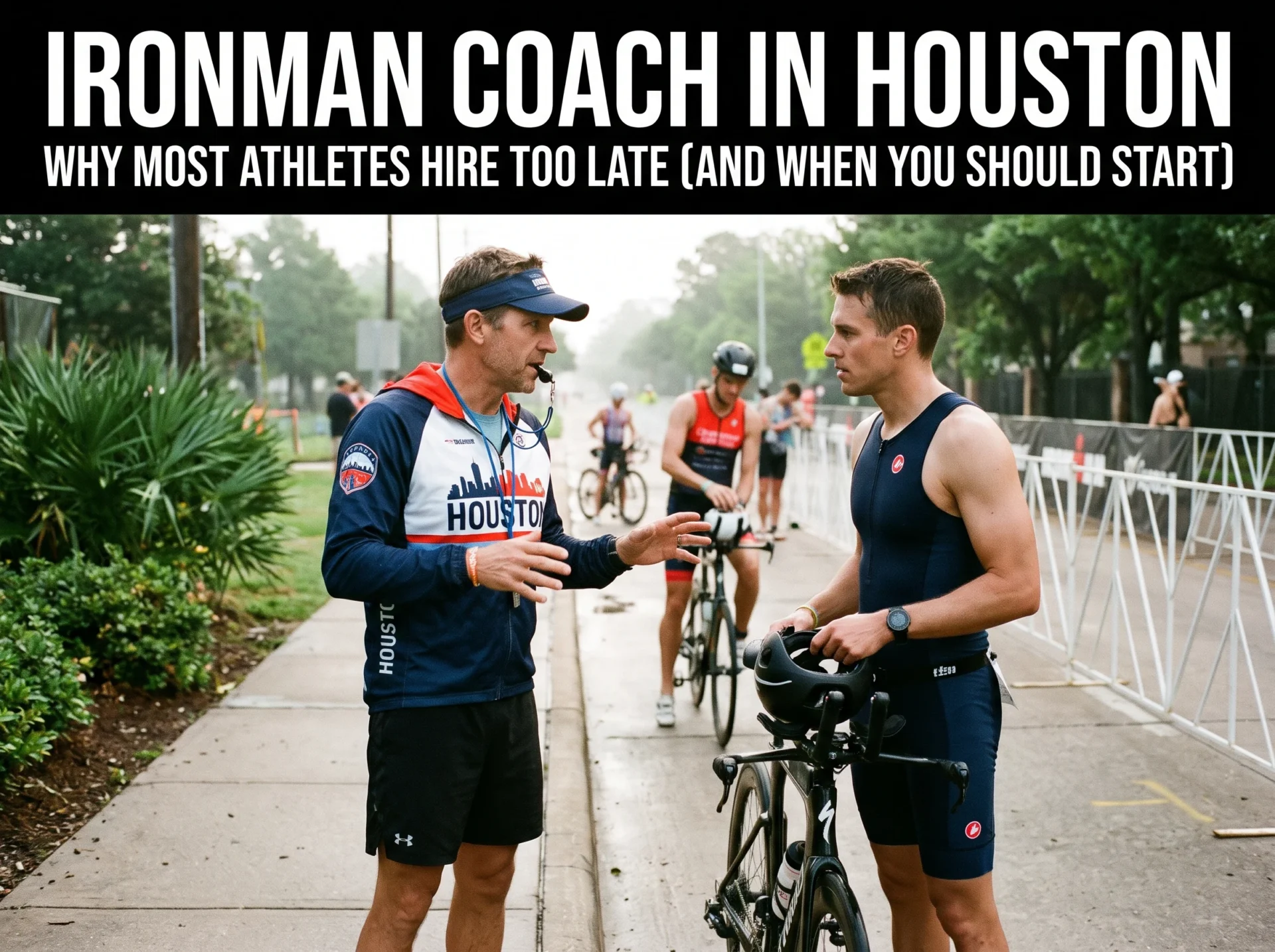
Ironman Coach in Houston: Start Training Early
October 24, 2026
Signs of Overtraining in Triathletes: Why Glycogen Recovery Matters More Than You Think
Key Takeaways
Here’s what you need to know about overtraining and glycogen recovery before we dive in:
- Overtraining affects 60% of elite runners — and shows up as declining performance despite increased effort, a resting heart rate 5-10 bpm above normal, and fatigue that drags on for weeks rather than days.
- Glycogen depletion is the hidden culprit — stores last only 90-120 minutes during intense exercise. Chronic low levels trigger systemic fatigue and a performance decline that’s hard to reverse.
- The 30-60 minute post-workout window is critical — consume 1.0-1.2g of carbohydrates per kilogram of body weight hourly for 4 hours to maximize glycogen restoration and keep overtraining at bay.
- Structured periodization is your best defense — alternate 2-3 week build phases with recovery weeks at 30% lower volume, include at least one full rest day weekly, and track HRV and resting heart rate for early warning signs.
- Female athletes face unique challenges — glycogen storage runs 12-25% lower during the mid-follicular phase, and the optimal recovery window shrinks to just 30 minutes, making carbohydrate timing around the menstrual cycle essential.
Your body adapts during recovery, not during training. Rest and proper fueling aren’t optional extras — they’re part of the plan.
Have you noticed your performance declining despite pushing harder in training? You’re not imagining it. Studies reveal that approximately 60% of elite runners face signs of overtraining during their careers, compared with 33% of nonelite runners. Triathletes face an even steeper challenge — three disciplines mean three times the opportunity for training stress to spiral out of control.
This article breaks down overtraining symptoms and overtraining syndrome, explains why glycogen depletion sits at the center of the problem, and covers practical recovery strategies you can act on. Female athletes will find specific guidance on how hormonal cycles affect glycogen and recovery windows. Understanding these warning signals early can save you months of lost fitness — and a lot of frustration.
Understanding Overtraining Syndrome in Endurance Athletes
What Is Overtraining
Overtraining syndrome isn’t just feeling tired after a hard week. It occurs when training intensity or frequency outpaces your body’s ability to recover, causing breakdown instead of adaptation. That distinction matters. Normal training fatigue fades after a day or two of rest. Overtraining syndrome produces systemic fatigue where performance drops and recovery stretches into weeks or months.
Healthcare providers classify the condition into three stages based on affected body systems. Stage 1 produces mild symptoms that mimic typical post-training soreness – easy to dismiss and easy to miss. Stage 2 hits your sympathetic nervous system, triggering your fight-or-flight response. Stage 3 targets your parasympathetic nervous system and proves the most severe, often requiring the longest road back. Here’s the catch – this progression isn’t always linear. You can land in any stage without moving through the others in order.
Functional vs Non-Functional Overreaching
Some training fatigue actually works in your favor. Functional overreaching represents planned, productive fatigue from progressive overload. Your body experiences acute fatigue and a temporary dip in performance, but bounces back to normal or improved function within days to two weeks. That recovery window triggers super-compensation – your fitness climbs beyond its previous ceiling.
Non-functional overreaching is a different story. The training stress looks identical from the outside, but your body cannot positively adapt without extended rest. Performance suffers for weeks to months, and instead of gaining training adaptations, you lose them. Push through without addressing the problem, and overtraining syndrome sets in – potentially requiring months to reclaim your previous capabilities.
The Triathlete’s Unique Challenge
Single-sport athletes face overtraining risks. Triathletes face them across three disciplines at once. The pull to train hard in swimming, cycling, and running simultaneously stacks training stress in ways that accumulate fast. Up to 65% of elite athletes experience overtraining at some point in their careers, and overtraining syndrome ranks as the leading cause of injury in elite Ironman athletes.
Your life outside training counts too. Age-group triathletes juggle full-time jobs, family commitments, and long training hours all at once. Rest gets cut first. Sleep suffers next. Your body ends up constantly playing catch-up. Here’s what most athletes don’t realize – your hormonal system cannot tell the difference between life stress and training stress. Both drain the same recovery reserve, creating a deficit that feeds directly into overtraining risk.
Key Overtraining Symptoms Every Triathlete Should Know
Declining Performance Despite Increased Effort
Here’s the cruel irony of overtraining: the harder you push, the slower you get. Your swim splits stall. Bike watts drop. Run pace slows. All while you’re maintaining or even increasing training volume.
An overtrained athlete shows a maximal heart rate that’s 5-10 beats per minute lower than normal. Workouts that once felt manageable suddenly demand everything you have. Your body hasn’t changed its output – everything just feels harder. That gap between effort and result is one of the clearest warning signals your body can send.
Persistent Fatigue and Prolonged Muscle Soreness
Normal training soreness follows a predictable pattern. Delayed onset muscle soreness peaks within one to three days and gradually fades. Overtraining soreness doesn’t follow those rules.
Fatigue sets in when your body repeatedly fails to recover fully between sessions. You feel excessively drained during workouts – sometimes before they even finish. Muscles stay tender, weak, and tight long after the initial pain should have subsided. Injuries linger. Soreness that refuses to leave isn’t toughness – it’s your body waving a red flag.
Elevated Resting Heart Rate and Poor Recovery
Track your morning resting heart rate two or three days after hard workouts. An increase of 5 bpm or more strongly indicates overtraining. Overtrained runners in research studies showed an average resting heart rate increase of 10 bpm – that’s a significant shift your body is broadcasting every morning if you pay attention.
Heart rate variability tells a similar story. Push too hard for too long and HRV drops noticeably. A slower post-exercise heart rate recovery signals your nervous system is struggling to reset. These numbers don’t lie.
Mood Changes and Loss of Motivation
Stress hormone imbalances do more than wreck your workouts – they affect your entire emotional landscape. Irritability creeps in. Anxiety spikes over minor frustrations. Activities you once loved start feeling like obligations.
Don’t dismiss these shifts as mental weakness. Difficulty staying motivated stems from both physical exhaustion and genuine hormonal disruption. Your mind and body are running on empty simultaneously, and no amount of willpower closes that gap.
Increased Illness and Weakened Immunity
Overtraining doesn’t just slow you down – it opens the door to illness. Your immune system takes a direct hit, making you far more susceptible to infections and upper respiratory tract infections. Research on elite athletes found that 33% of missed training days came down to infection, with respiratory tract infections leading the list.
Prolonged exercise creates what researchers call an “open window” – a period of decreased protection where viruses and bacteria gain easy entry. Getting sick repeatedly during a heavy training block isn’t bad luck. It’s a symptom.
The Glycogen Connection: Why It Matters for Triathlon Recovery
What Happens When Glycogen Stores Run Low
Your legs go heavy. Your watts crumble. Your pace collapses. Sound familiar? That sudden wall you hit during a long training block isn’t weakness – it’s glycogen depletion doing its worst.
Muscle glycogen content correlates directly with endurance capacity during prolonged cycling. When stores exhaust, continuing exercise becomes nearly impossible. Your muscles scream for ATP that your body simply cannot produce fast enough, leaving you with reduced power output and that unmistakable cement-in-the-legs sensation. Muscle glycogen stores last, on average, 90-120 minutes of continuous moderate-to-high intensity exercise. For triathletes training across three disciplines, that window disappears fast.
How Chronic Low Glycogen Leads to Overtraining
Here’s the problem most triathletes miss. One depleted session is manageable. Consecutive days of training on low glycogen stores is where things break down.
Swimmers who failed to respond to increased training loads shared a common thread – low glycogen levels and insufficient carbohydrate intake. Their bodies weren’t adapting. They were deteriorating. Delay your post-exercise nutrition by just two hours and glycogen resynthesis rates drop by close to 45%. Full glycogen repletion can take up to 24 hours, because the maximal synthesis rate sits at only 10 mmol/kg wet weight per hour. Train again before that window closes and you’re stacking fatigue on top of fatigue – a direct path toward overtraining syndrome.
Glycogen and Central Fatigue in Endurance Sports
The glycogen story doesn’t stop at your muscles. Your brain pays the price too.
After 120 minutes of running, brain glycogen levels drop significantly – between 34-60% across five discrete brain regions. That mental fog you experience late in a long training block? The loss of sharpness and motivation? Glycogen depletion plays a direct role. Low blood sugar accompanying depleted stores serves as a key indicator of central fatigue during prolonged exercise. Your body and brain are running on empty simultaneously.
The Female Athlete Perspective on Glycogen Depletion
Female athletes carry an additional layer of complexity. Glycogen storage runs 12-25% lower during the mid-follicular phase compared to the mid-luteal phase. The optimal post-exercise recovery window narrows to just 30 minutes. That’s half the time most general guidance recommends.
Female athletes who menstruate benefit most from prioritizing dietary carbohydrate specifically during the follicular phase. Timing carbohydrate intake around your cycle isn’t optional fine-tuning – it’s a fundamental part of staying ahead of overtraining risk.
Overtraining Recovery and Prevention Strategies
Structured Rest and Periodization
More training does not always mean better results. The athletes who improve consistently are the ones who plan their recovery as carefully as their workouts.
Structure your training in 2-3 week build phases, then follow each block with a recovery week where you cut volume by roughly 30%. Research confirms that periodized training plans produce better fitness gains than programs that continuously pile on mileage without scheduled down weeks. Schedule deload weeks every 4-6 weeks to keep fatigue from accumulating unchecked.
One number worth tracking: your acute-to-chronic workload ratio. Keep it between 0.8 and 1.3. When weekly training load spikes by 15% or more, injury risk climbs sharply. That single metric can tell you more about your overtraining risk than almost anything else.
Carbohydrate Timing and Glycogen Restoration
Your muscles don’t wait around. The 30-60 minute window after exercise is when glycogen resynthesis happens fastest. Miss it, and you’re already playing catch-up heading into your next session.
Target 1.0-1.2g of carbohydrates per kilogram of body weight per hour during the first 4 hours post-exercise to maximize muscle glycogen resynthesis. For a 70kg athlete, that’s 84 grams of carbohydrates per hour. Muscle stays receptive to nutrient intake for up to 2 hours, but earlier is always better.
Treat post-workout nutrition like a training session. Skip it, and you undermine everything you just worked for.
Monitoring Tools: Heart Rate and Training Load
Your body sends warning signals before overtraining sets in. The key is actually listening to them.
Measure heart rate variability daily using a consistent protocol and compare each reading against your 30-day rolling baseline. A declining HRV trend held over 3-4 weeks signals that your training stress has outpaced your recovery capacity. Watch your resting heart rate too — a rise of 5 bpm or more warrants immediate attention.
These numbers tell you what you can’t always feel until it’s too late.
Building Recovery Into Your Training Plan
Rest days are not wasted days. They’re where fitness actually gets built.
Schedule at least one full rest day every week, and bump that to two during recovery weeks. Active recovery through low-intensity activities like walking, yoga, or easy swimming keeps blood moving and supports tissue repair without adding to your training load.
The triathletes who stay healthy across a full season aren’t the ones who train the hardest. They’re the ones who recover the smartest.
Conclusion
Without doubt, recognizing overtraining symptoms early can save months of lost training and performance decline. Glycogen recovery matters as much as your workout intensity, and monitoring tools like heart rate variability provide actionable insights. Structure your training with proper periodization, fuel adequately within that critical 30-60 minute window, and respect rest days. Your body adapts during recovery, not during training, so make restoration a priority rather than an afterthought.
FAQs
Q1. What are the main warning signs that a triathlete is overtraining? Key signs include declining performance despite increased effort, persistent fatigue and prolonged muscle soreness, elevated resting heart rate (5-10 bpm higher than normal), mood changes like irritability and loss of motivation, and increased susceptibility to illness. If you notice your swim splits stalling, bike watts dropping, and run pace slowing while training volume stays the same or increases, these are clear indicators of overtraining.
Q2. How long does it typically take to recover from overtraining syndrome? Recovery time depends on the severity of overtraining. Functional overreaching requires days to two weeks of rest to bounce back. Non-functional overreaching can take weeks to months for performance to return. Full-blown overtraining syndrome may require several months of reduced training or complete rest to restore normal performance capabilities. The earlier you recognize the symptoms, the shorter your recovery period will be.
Q3. Which types of exercise deplete glycogen stores the fastest? Moderate-to-high intensity continuous exercise depletes glycogen most rapidly, with muscle glycogen stores typically lasting 90-120 minutes. For triathletes, this means long bike rides and sustained running efforts drain glycogen quickly. The depletion rate increases with exercise intensity, and training across three disciplines without adequate carbohydrate replenishment accelerates the process significantly.
Q4. Why is glycogen recovery so important for preventing overtraining in triathletes? Chronic low glycogen levels directly contribute to overtraining by causing persistent fatigue and performance decrements. When glycogen stores remain depleted from consecutive days of training, your body cannot properly adapt or recover. Low glycogen also affects brain function, contributing to central fatigue. Consuming 1.0-1.2g of carbohydrates per kilogram of body weight within 30-60 minutes post-exercise maximizes glycogen restoration and helps prevent overtraining.
Q5. How can I monitor my training to avoid overtraining syndrome? Track your resting heart rate daily—an increase of 5 bpm or more signals potential overtraining. Monitor heart rate variability (HRV) using consistent protocols and compare to your 30-day baseline; declining HRV for 3-4 weeks indicates excessive training stress. Maintain an acute-to-chronic workload ratio between 0.8-1.3, and structure your training with periodization that includes recovery weeks every 4-6 weeks where you reduce volume by approximately 30%.