
How to Train Your Glutes for Speed: Essential Guide for Runners
October 2, 2025
Why Elite Runners Rely on Sports Massage Therapy
October 8, 2025
Here’s a startling reality: swim errors plague over 60% of freestyle swimmers. Recent studies of competitive swimmers reveal that 61.3% drop their elbows during the pull-through phase, 46.8% maintain an eyes-forward head position, and 45.2% use incorrect hand entry positions.
Even Olympic swimmers spend countless hours perfecting techniques that look effortless. Don’t worry – you’re not alone if freestyle feels frustrating. Many swimmers master the basic movements quickly but struggle with the finer details that separate efficient swimming from exhausting thrashing.
The most common culprits? Lifting your head too high, letting your hips sink like anchors, and creating unnecessary drag with poor body position. These mistakes turn what should be smooth swimming into an uphill battle against the water.
Your body should lie nearly parallel to the pool bottom – think two-thirds submerged, one-third above the surface. Proper hand entry happens at shoulder width, imagine hitting 11 and 1 on a clock face. The Early Vertical Forearm technique creates maximum grip on the water for powerful pulls.
Swimming without addressing these fundamental errors wastes your pool time and energy. The techniques we’ll cover can turn your stroke from a struggle into something that actually feels natural and fast.
Fixing Head and Body Position
Remember the last time you watched an experienced swimmer glide effortlessly down the lane? Their secret isn’t hidden strength or endless endurance – it’s proper head position creating a chain reaction of efficient technique.
Looking forward instead of down
Most swimmers develop a habit of looking forward constantly, never dropping their gaze at the critical surge point. This defensive behavior makes sense in crowded lanes where collision avoidance becomes priority number one. The problem? This safety-first approach creates massive technical issues.
Your head belongs in a neutral position with eyes pointing straight down. Think of your spine as a rigid rod running from skull to tailbone – any deviation disrupts stability and power transfer throughout your stroke cycle. Drop that forward gaze and watch your speed increase while effort decreases.
How head position affects hip alignment
Picture your body as a seesaw with your chest serving as the pivot point. Basic physics applies here – lift one end and the other drops automatically. Raise your head and your hips plummet like stones, creating exactly the drag you’re trying to avoid.
Head position controls everything behind it. Maintain proper alignment and your hips float naturally toward the surface. This streamlined position cuts water resistance dramatically, letting you swim faster with significantly less energy expenditure.
Try this simple test: float face-down in shallow water, then lift your head as if looking forward. Notice how your hips and legs drop immediately. This demonstrates the direct connection between head and hip positioning that many swimmers never realize exists.
Using the black line to guide your gaze
That black line painted on the pool bottom isn’t just decoration – it’s your navigation system for efficient swimming. Lock your eyes on that line from push-off to wall touch.
Here’s the rule: head up means hips down. The black line provides constant visual feedback, preventing your head from drifting upward during stroke fatigue. Plus, following the line keeps you swimming straight instead of zigzagging across lanes and wasting precious energy.
Correcting Arm and Hand Mechanics
Your arms generate up to 90% of freestyle propulsion. Master these movements and you’ll discover dramatic improvements in swimming efficiency that most swimmers never achieve.
Crossing over on hand entry
Crossover happens when your hands enter the water inside your shoulders, sometimes crossing your body’s centerline. This creates what coaches call “wiggle-butt” – a serpentine swimming pattern that wastes energy. Even worse, it forces your next movement outward instead of catching water, setting you up for shoulder problems down the road.
Your hands should hit the water directly in line with your shoulders – picture those 11 and 1 o’clock positions on a clock face. The catch-up drill works perfectly here: stop your recovery arm directly above your head to reinforce shoulder-width entry.
Pulling with a straight arm
Most swimmers think straight-arm pulling is wrong. The reality? Elite 50-meter sprinters like Anthony Ervin and Roland Schoeman use this technique because deeper pulls engage the powerful latissimus dorsi and pectoralis muscles. Tests with Olympic sprinter Brad Tandy showed a .026 m/sec advantage with deeper pulling motion in sprints.
Distance swimmers need a different approach. Events longer than 50 meters require a higher elbow position to reduce drag. Your race distance determines your optimal pulling technique.
Dropped elbow during recovery
A staggering 53.2% of swimmers drop their elbows during recovery. This happens when your elbow sinks below your wrist, often causing your elbow to enter the water before your hand. The result? Increased shoulder strain and compromised hand entry.
Your elbow should remain the highest point during recovery, though only slightly higher than your wrist and shoulder. Skip traditional drills like thumb drag or fingertip drag – these exaggerate high elbow positions and stress your shoulders unnecessarily.
How to use early vertical forearm (EVF)
Early Vertical Forearm positions your arm for maximum water grip early in your catch phase. Here’s the technique:
- After hand entry, press your forearm and hand downward as one unit
- Keep elbows pointing outward (not backward)
- Maintain high elbow position as forearm becomes vertical
- Engage your lat muscles to pull only after achieving vertical forearm
This creates a larger surface area, turning your entire forearm into a paddle. Practice EVF freeze, head-up scooter, or fist drill to lock in proper mechanics.
Improving Breathing Technique
Have you ever wondered why some swimmers glide effortlessly down the pool while others gasp and struggle after just a few laps? The difference often comes down to breathing technique – the skill that can make or break your freestyle stroke.
Lifting head to breathe
Picture this scenario: you’re swimming along, feeling good, then you lift your head forward to breathe. Suddenly your legs feel like they’re dragging behind you. This happens because lifting your head forward creates a domino effect – your hips and legs automatically drop, dramatically increasing drag and tiring you out faster.
Your body works like a perfectly balanced seesaw. When one end goes up, the other must come down. Use your body’s natural rotation to bring your head to the side for breathing while keeping it aligned with your spine. Your forward momentum creates a small air pocket (bow wave) just big enough for a quick breath.
Holding breath underwater
Many swimmers hold their breath while swimming, yet you’d never do this while running or cycling. Here’s what’s actually happening in your body: the urge to breathe isn’t driven by lack of oxygen but by CO2 buildup in your blood and brain.
The solution? Exhale continuously while your face is underwater, blowing out forcefully just before turning to breathe. This creates a vacuum in your lungs, allowing air to rush in naturally when you rotate. Think of it as clearing the way for fresh air to flow in.
One goggle rule for side breathing
Elite swimmers follow a simple but effective principle: the “one goggle rule.” Keep one eye and one ear underwater during each breath. This technique maintains proper body alignment and creates minimal disruption to your horizontal position.
Start practicing this in shallow water where you can stand, then progress to swimming drills where you focus on breathing with exactly half your head in the water.
Exhaling through the nose
Your nose becomes a powerful tool for efficient breathing patterns. Exhaling through your nose while underwater offers significant advantages – it allows you to focus solely on inhaling when your mouth clears the water.
Try this technique: exhale slowly through both nose and mouth while your face is submerged, then empty your lungs completely just before your next breath. This pattern creates rhythm in your stroke, helping maintain consistent pace and intensity. The rhythm becomes as natural as your heartbeat once you master it.
Fixing Kick and Rotation Issues
Your legs contribute up to 40% of propulsion in freestyle swimming. Many swimmers unknowingly sabotage their performance through kick and rotation errors that seem minor but create major drag.
Kicking from the knees
Have you noticed your knees popping above the surface when you kick on your back? That’s the telltale sign of knee-driven kicking instead of hip-driven power. Proper freestyle kick requires only about 120 degrees of knee bend – similar to your natural walking motion.
Focus on driving the movement from your hips. Keep your legs relatively straight with minimal knee flexion. Think of your legs as long, flexible whips generating power from the core rather than hinges bending at the joints.
Over-rotating the body
Your hips, torso, and shoulders should rotate together as one unit along your central axis. Over-rotation happens when your shoulder line creates a 90-degree angle with the pool floor. This destabilizes your entire stroke and wastes precious energy.
Maintain balance by focusing on hip drive with each arm stroke. The rotation should feel controlled, not like you’re rolling side to side in rough water.
Kick timing and amplitude
Your kick timing mirrors natural walking patterns – when your left arm moves forward, your right leg kicks down. This two-beat pattern assists body rotation and engages your core muscles effectively.
Limit kick amplitude to approximately 18 inches for optimal balance between propulsion and drag. Bigger isn’t always better when it comes to kick width.
Using fins and kickboards for practice
Fins naturally encourage hip-driven kicks and narrower kick patterns. For freestyle practice, grab the back of a kickboard with your face in the water rather than holding it conventionally.
Consider scheduling a swim stroke analysis to eliminate guesswork in perfecting your technique. Sometimes an outside eye catches errors you can’t feel in the water.
Conclusion
Freestyle swimming presents a beautiful paradox – the stroke looks simple but demands precision in every movement. Each element we’ve covered connects to the others like links in a chain. Your head position affects your hips. Your breathing rhythm impacts your stroke timing. Your kick drives your rotation.
The reality? Most swimmers spend months or even years swimming with technique flaws that hold them back. You’re already ahead of the game by understanding these common errors and their fixes.
Remember that perfect freestyle technique takes time to develop. Don’t expect to master everything in your next pool session. Pick one area – maybe your head position or breathing pattern – and focus on that for a few weeks. Once it feels natural, add another element.
Your body will resist these changes at first. That’s normal. Years of muscle memory don’t disappear overnight. Stay patient with yourself during this process.
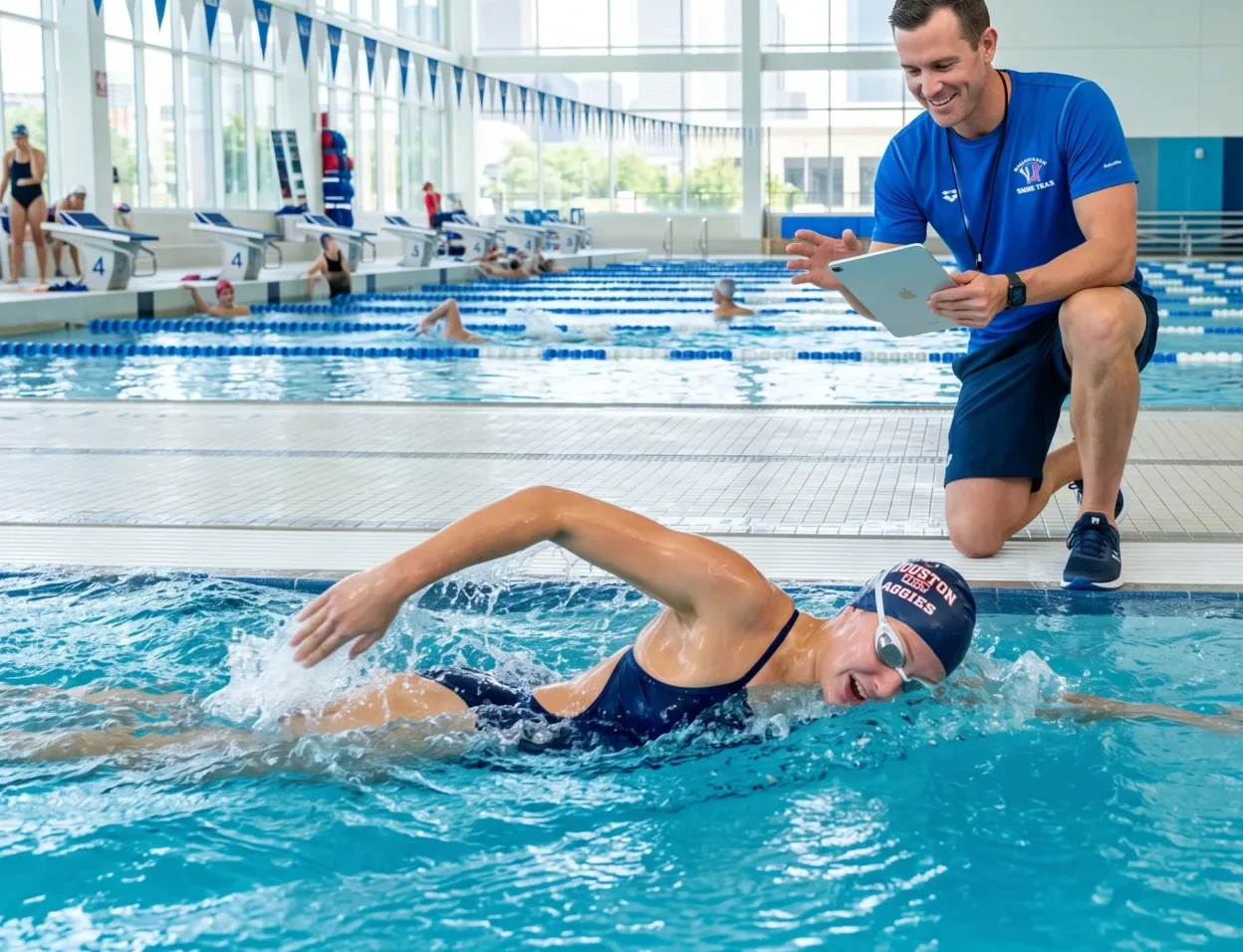
Consider working with a coach or filming yourself from underwater if possible. Sometimes we think we’re doing something correctly when we’re not. External feedback reveals blind spots that self-assessment misses.
The improvements will come. You’ll notice your strokes becoming more efficient. Swimming will feel less like fighting the water and more like working with it. Those previously exhausting 500-meter sets might start feeling manageable.
These technique changes don’t just make you faster – they help prevent shoulder injuries and reduce the energy cost of each stroke. That means more enjoyable swimming and better endurance for longer distances.
Are you ready to put these fixes into practice? Your next pool session could be the start of a smoother, more efficient freestyle stroke.
Key Takeaways
Master these fundamental freestyle corrections to transform your swimming from inefficient to fluid, reducing drag and increasing speed while preventing common injuries.
• Keep your head down and eyes focused on the pool’s black line – looking forward causes hips to sink and creates unnecessary drag that slows you down significantly.
• Enter hands at shoulder width (11 and 1 o’clock positions) – crossing over the midline creates a wiggling motion and reduces stroke efficiency.
• Rotate to breathe, don’t lift your head – use body rotation and the “one goggle rule” to maintain streamlined position while getting air.
• Kick from your hips, not your knees – limit knee bend to 120 degrees and drive movement from hips for maximum propulsion with minimal energy waste.
• Exhale continuously underwater through your nose – this prevents CO2 buildup and creates a natural vacuum for easier inhalation when you rotate to breathe.
Remember that these techniques work together as an interconnected system – fixing one element often improves others, creating a compound effect that dramatically enhances your overall swimming performance.
Is Self-Learning Enough to Avoid Common Errors in Freestyle Swimming?
While self-learning can provide valuable insights into freestyle swimming techniques, it may not address all common errors. Adult swim lessons or selflearning offer structured guidance, helping individuals perfect their form, breathing, and strokes. Combining both methods ensures a more comprehensive understanding and reduces the risk of developing bad habits in the water.
FAQs
Q1. What are the most common freestyle swimming mistakes for beginners? Common mistakes include improper head position, crossing the midline with hand entry, inefficient breathing technique, kicking from the knees instead of the hips, and not engaging the core muscles properly.
Q2. How can I improve my freestyle swimming technique? Focus on maintaining proper body alignment, keeping your head down with eyes looking at the bottom of the pool, entering hands at shoulder width, rotating your body with each stroke, and exhaling continuously underwater. Practice drills to reinforce good habits and consider getting feedback from a coach.
Q3. Why do I get tired quickly when swimming freestyle? Fatigue often results from inefficient technique. This can include poor body position causing drag, improper breathing leading to oxygen debt, overusing arm strength instead of body rotation, or kicking too vigorously. Improving your form and pacing can help conserve energy.
Q4. What is the correct breathing technique for freestyle swimming? Rotate your head to the side to breathe, keeping one goggle in the water. Exhale continuously underwater through your nose and mouth, then take a quick breath as you rotate. Avoid lifting your head forward or holding your breath, as these create drag and disrupt your rhythm.
Q5. How can I prevent shoulder injuries while swimming freestyle? Use proper technique, including a high elbow catch and early vertical forearm position. Avoid crossing the midline on hand entry. Incorporate shoulder strengthening exercises, and gradually increase training volume. If you experience pain, consult a coach or physical therapist to address any form issues.